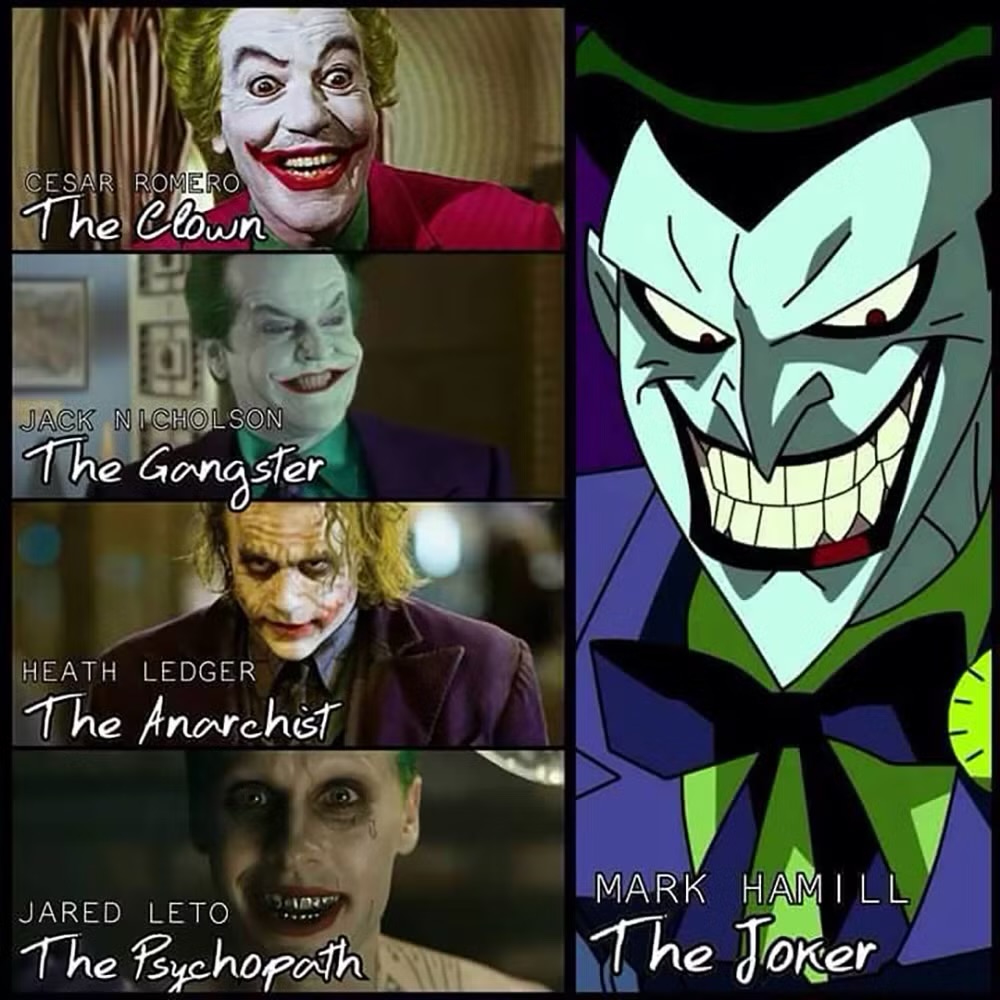

Cesar Romero – “The Clown” (1960s Batman TV series)
Romero’s Joker embodied pure theatrical mischief. With his painted-over mustache still visible beneath white makeup, he delivered a gleefully campy performance focused on elaborate pranks and gimmicks rather than genuine menace. This version was deliberately family-friendly – a colorful trickster who relished in chaos but rarely crossed into truly disturbing territory. His exaggerated laugh and flamboyant gestures established the character’s theatrical foundation.
Jack Nicholson – “The Gangster” (Batman, 1989)
Nicholson brought a mobster sensibility to the role, portraying the Joker as a vain, vindictive crime boss with a twisted artistic streak. His character began as gangster Jack Napier before his transformation, maintaining criminal ambitions enhanced by newfound madness. This Joker was equal parts showman and ruthless criminal, concerned with status and recognition while indulging in theatrical mass murder. Nicholson balanced humor with genuine menace, creating a flamboyant villain with clear underworld connections.
Mark Hamill – “The Joker” (Batman: The Animated Series, 1992-present)
Hamill’s iconic voice performance represents perhaps the most balanced and quintessential version – simply “The Joker.” Through vocal performance alone, he captures the character’s mercurial nature, effortlessly shifting between playful humor and chilling malevolence. His Joker laughs because he genuinely finds horror amusing, making him unpredictable and deeply unsettling. Hamill’s version combines elements of all other interpretations – theatrical flair, criminal cunning, anarchistic philosophy, and psychopathic detachment – while maintaining the core essence of a character who finds perverse joy in Batman’s world.
Heath Ledger – “The Anarchist” (The Dark Knight, 2008)
Ledger reimagined the Joker as a philosophical terrorist determined to expose societal hypocrisy. With no clear origin and describing himself as “an agent of chaos,” this Joker rejected conventional criminal motivations like money or power. Instead, he orchestrated elaborate social experiments designed to break down moral codes and prove that civilization is a fragile construct. His disheveled appearance, scarred smile, and unnerving mannerisms created a distinctly unsettling presence focused on dismantling social order rather than personal gain.
Jared Leto – “The Psychopath” (Suicide Squad, 2016)
Leto’s controversial interpretation presented a modern criminal kingpin with extreme narcissism and sadistic tendencies. Heavily tattooed and visually distinctive, this version emphasized unpredictable violence and possessive obsession, particularly regarding Harley Quinn. His Joker was less philosophical than Ledger’s but more deliberately cruel – a character who enjoyed inflicting pain rather than using it to make broader points. This interpretation leaned into the character’s psychosexual elements while positioning him as a modern underworld figure.
Joaquin Phoenix – “The Outcast” (Joker, 2019)
Phoenix portrayed a lonely, mentally ill man systematically failed by every support system. His Arthur Fleck wasn’t born villainous but was shaped by relentless rejection, mockery, and institutional neglect. This version uniquely showed the character’s formation from a sympathetic perspective, creating uncomfortable tension as viewers witness his gradual radicalization. Phoenix’s Joker ultimately becomes a symbol for others who feel similarly marginalized, accidentally inspiring a movement through his violent rejection of a society that had already rejected him.
 Balductum Musings
Leave a comment