Freedom, Possession, and the Fracture of Intimacy in Nicolas Roeg
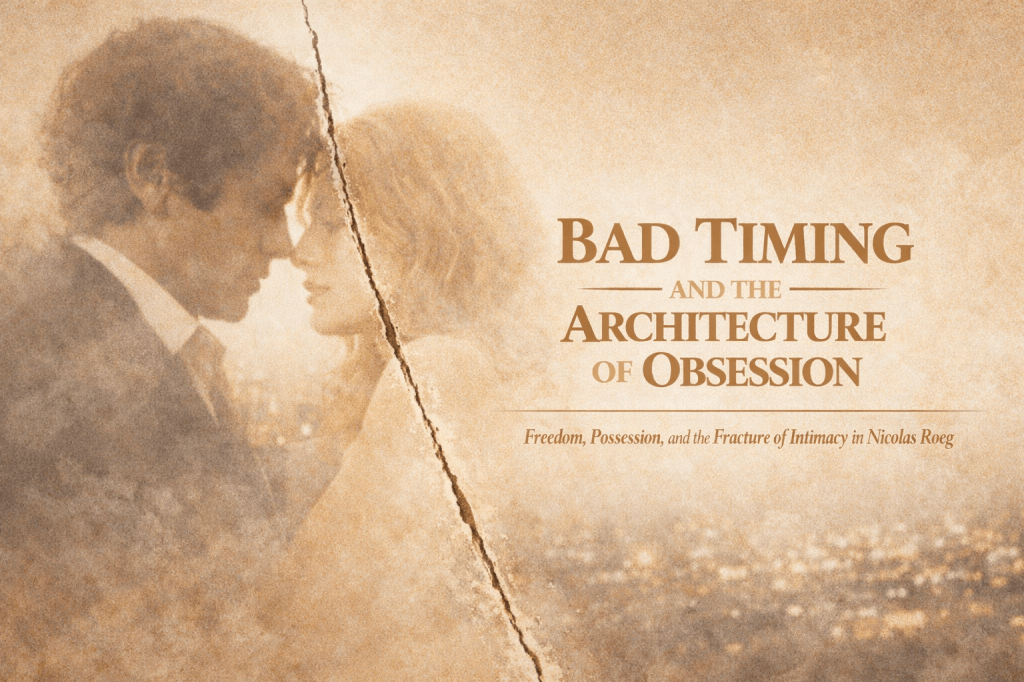
Preface
This essay approaches Bad Timing (1980) not as a scandal to be adjudicated nor as a relic to be defended, but as a structure to be entered. Its method is hybrid: discursive rather than footnoted, analytic without academic apparatus, attentive to psychology, philosophy, criminology, aesthetics, and reception history without subordinating the film to any single interpretive regime. What follows is not a verdict but an excavation.
The twenty sections unfold deliberately. The opening movements situate the film within its material and cultural conditions—production history, institutional repudiation, early critical recoil. From there, the essay turns inward to the film’s fractured narrative architecture, examining how non-linear chronology reshapes moral perception. The central constellation of characters—Milena, Alex, Stefan, and Inspector Netusil—emerges next, each approached first descriptively, then through competing interpretive lenses.
Subsequent sections stage a series of tensions: Milena as pathological versus Milena as Dionysian; Alex as narcissistic offender versus Alex as Romantic sufferer; the relationship viewed through existential philosophy versus criminological accountability. These frameworks are not reconciled but allowed to remain in productive conflict. Only after this layering does the essay articulate affirmative and negative moral currents embedded within the film’s design.
The closing movements trace the film’s investigative intelligence, its initial rejection, its institutional rehabilitation—most notably through The Criterion Collection—and its contemporary standing as one of Nicolas Roeg’s defining works.
Throughout, the guiding premise is simple: “Bad Timing” is a film about possession, freedom, and the instability of narrative control. To read it adequately requires resisting simplification. This essay invites that resistance.
[1] A Film Disowned: Production, Provocation, and the Architecture of Discomfort
When Nicolas Roeg released Bad Timing in 1980, he delivered not merely another provocation in a career already defined by fractured time and erotic unease, but a film that seemed intent on testing the limits of institutional tolerance. Starring Art Garfunkel—known to most audiences as half of Simon & Garfunkel—and the then-emergent Theresa Russell, the film arrived already destabilized by expectation. Garfunkel as a Viennese psychoanalyst was a casting gesture that felt at once perverse and precise; Russell’s Milena radiated an emotional rawness that would become inseparable from Roeg’s aesthetic universe, not least because the two would later marry.
The production’s most notorious anecdote—now inseparable from the film’s mythology—remains the reaction of the Rank Organisation. So repelled were they by the finished work that they removed their logo and dismissed it as “a sick film made by sick people for sick people.” That repudiation did more than wound; it consecrated the film’s outsider status before audiences even encountered it. Institutional disgust became part of the text’s aura.
Set largely in Vienna, the film embeds its intimate violence within a city synonymous with psychoanalysis, fin-de-siècle decadence, and aesthetic refinement. Roeg’s Vienna is not merely a backdrop but a visual counterpoint: imperial architecture, baroque interiors, and the spectral presence of Gustav Klimt’s paintings form a cultivated skin stretched over psychological brutality. Klimt’s gilded surfaces—sensuous, ornamental, erotic—become more than décor; they operate as recurring visual motifs, echoing the tension between beauty and possession that animates the central relationship.
Roeg’s narrative, told in his characteristic non-linear fashion, refuses chronological comfort. Events are scattered, rearranged, refracted through memory and interrogation. This temporal fragmentation—already visible in his earlier work—here becomes inseparable from the film’s moral architecture. The story does not unfold; it accumulates, circling an act whose full horror is withheld, deferred, and finally exposed.
The soundtrack further complicates tonal expectation. Songs by Tom Waits and The Who coexist with classical compositions by Richard Strauss, creating a sonic collage that moves between the contemporary and the canonical. This layering mirrors the film’s visual strategy: the raw and the refined share the same frame. Marketing materials, perhaps misunderstanding the severity of what they were selling, bore the subtitle “A Sensual Obsession,” a phrase that promises erotic heat but obscures the colder anatomy of control that Roeg was staging.
The British Board of Film Classification initially awarded the film an X rating, a designation that at the time carried both stigma and a narrowing of exhibition possibilities. Explicit sexuality and, more controversially, the depiction of sexual violence positioned the film in a precarious space between art cinema and exploitation in the public imagination. Yet the same year it provoked revulsion from its distributor, it also won the People’s Choice Award at the Toronto Festival of Festivals—a reminder that audiences are rarely monolithic in their response to discomfort.
For years, the film hovered in partial obscurity, difficult to see, its reputation sustained by anecdote and controversy. Its eventual restoration and release by The Criterion Collection in 2005 marked a decisive shift: what had once been denounced as pathological was reintroduced as canonical. Later, in 2011, Time Out would rank it among the greatest British films ever made. The arc from repudiation to consecration seems almost too neat, yet it underscores a central irony: a film once rejected as indecent would come to be admired for precisely the qualities that had unsettled its first custodians.
If Roeg’s cinema often concerns itself with bad timing in the emotional sense—the misalignment of desire and circumstance—then the film’s own history suggests another layer of irony. It may have been released into a cultural moment unprepared for its severity. But history, unlike its characters, has proven capable of revisiting, reassessing, and, eventually, recognizing the force of what it once recoiled from.
[2] Scandal and Misrecognition: The Anatomy of an Initial Rejection
The hostility that greeted Bad Timing upon its release cannot be reduced to prudishness alone, though prudishness played its part. The film’s most disturbing sequence—Alex’s sexual assault of the unconscious Milena—crossed boundaries that many critics and viewers in 1980 regarded as inviolable within serious cinema. It was not merely explicit; it was ethically disorienting. The scene refused catharsis, refused sensational flourish, and refused immediate moral framing. For many, this refusal felt indistinguishable from complicity.
The denunciation by the Rank Organisation, who famously branded it “a sick film made by sick people for sick people,” created a cloud of scandal before audiences could encounter the work on its own terms. Institutional repudiation became publicity, but of a corrosive kind. The withdrawal of the Rank logo signaled not just disagreement but disavowal, as though the film itself were morally contagious.
Compounding this unease was Roeg’s narrative method. His fragmented, non-linear structure—so central to the film’s psychological logic—was experienced by many viewers as unnecessarily opaque. Contemporary audiences are now well trained in temporal dislocation, but in 1980 such structural disassembly could feel like an act of aggression. The story’s refusal to unfold chronologically meant that sympathy shifted, hardened, and collapsed in unstable rhythms. Viewers were not guided; they were implicated.
Equally destabilizing was the absence of overt moral adjudication within the diegesis. Alex is not theatrically condemned by a chorus of outrage; the film does not stage a courtroom crescendo of denunciation. Instead, it presents his behavior with a clinical detachment that some critics interpreted as coldness. The question arose repeatedly: does the film expose, or does it aestheticize? The stylized imagery—Vienna’s elegance, Klimt’s eroticized surfaces, the carefully composed frames—led some to accuse Roeg of beautifying violence against women, a charge amplified by certain strands of feminist criticism at the time.
Marketing did little to clarify matters. The subtitle “A Sensual Obsession” promised something closer to an erotic thriller than the harrowing psychological dissection that audiences encountered. This mismatch between expectation and experience generated disappointment that easily turned to hostility. What was advertised as sensual proved instead accusatory.
The timing of the release did not help. The film emerged at the dawn of the Thatcher and Reagan eras, amid conservative cultural shifts in both the United Kingdom and the United States. Its frank sexuality and moral ambiguity clashed with a public atmosphere increasingly suspicious of permissiveness. Moreover, mainstream discourse around toxic relationships, consent, and psychological manipulation had not yet acquired the vocabulary that contemporary audiences now bring to such narratives. The film appeared before the language that might have contextualized it.
The X rating in the United Kingdom further constrained distribution and subtly aligned the film, in public perception, with pornography rather than with art cinema. Its European art-house sensibility—its references to Gustav Klimt, its austere pacing, its clinical tone—were dismissed by some Anglo-American critics as pretentious ornament rather than substantive engagement. The juxtaposition of Vienna’s high culture with intimate brutality produced a cognitive dissonance that many found alienating rather than illuminating.
Even casting became a point of friction. Art Garfunkel’s presence as Dr. Alex Linden disoriented viewers accustomed to his gentle folk persona. The disjunction between public image and predatory character unsettled audiences who perhaps preferred clearer moral alignments between actor and role. Roeg’s choice was deliberate, but deliberation does not guarantee comfort.
What unsettled critics most deeply, however, may have been the film’s resistance to simplification. Roeg refused to flatten his characters into heroes and villains, refused to package obsession into melodramatic clarity. In doing so, he challenged the moral frameworks that dominated commercial cinema of the period. Viewers were left without the reassurance of unequivocal condemnation within the narrative itself; they were forced instead to confront their own interpretive responsibility.
Yet the very qualities that generated rejection—formal audacity, moral ambiguity, aesthetic severity—would later form the basis of the film’s rehabilitation. What was once dismissed as exploitation came to be reconsidered as unflinching examination. The scandal, in retrospect, appears less as evidence of artistic failure than as testimony to the discomfort produced when cinema refuses to flatter its audience.
[3] Fractured Chronology: Narrative as Psychological Excavation
If the scandal surrounding Bad Timing prepared audiences for transgression, the film’s narrative structure ensured that transgression would not be consumed in a single, coherent gesture. The story begins not with romance but with crisis: Milena Flaherty is rushed to a hospital in Vienna after an apparent overdose of pills and alcohol. At her side is Dr. Alex Linden, American psychoanalyst, lover, and—though the film withholds this knowledge at first—something far more troubling. From the outset, the viewer is positioned not as confidant but as investigator.
The structuring device is the inquiry conducted by Inspector Netusil, whose questioning becomes the frame through which the past is disassembled and rearranged. Alex recounts, deflects, reconstructs. The film moves backward and forward in time, shifting between hospital corridors, interrogation rooms, and the earlier phases of a relationship that began with immediate attraction at a party. Milena, still married to the older Czech Stefan Vognic—who resides in Bratislava while she lives in Vienna—enters Alex’s life as a force of spontaneity that both fascinates and destabilizes him.
Their affair intensifies rapidly. Passionate encounters give way to arguments, reconciliations, renewed desire. Milena’s refusal to sever ties with Stefan, her insistence on maintaining autonomy, begins to corrode Alex’s composure. What appears at first as romantic intensity gradually reveals itself as something more invasive. Alex checks her mail, spies on her interactions, monitors her movements. Surveillance replaces intimacy. The relationship deteriorates under the pressure of his demands for exclusivity and her resistance to confinement.
When Milena decides to leave Vienna, Alex spirals into jealousy and desperation. The night of the overdose becomes the gravitational center around which all temporal fragments orbit. Milena calls Alex in distress. He delays going to her apartment—a delay that will become central to Netusil’s suspicion. When he finally arrives, he finds her unconscious. What happens next, though withheld initially from both inspector and audience, redefines the entire narrative. Instead of immediately calling for help, Alex sexually assaults her before contacting emergency services.
Roeg refuses to present this revelation as a singular shock. Rather, it emerges through the gradual dismantling of Alex’s account. During interrogation, he constructs a false timeline, attempting to conceal the sequence of events. Netusil’s careful reconstruction of movements, phone calls, and physical details exposes the fissures in Alex’s story. The truth is not delivered; it is excavated.
Milena survives. The survival complicates the moral landscape; there is no tragic finality to seal the event into melodrama. Alex, however, faces consequences as the inspector uncovers the reality of what transpired. Yet even here, Roeg avoids tidy resolution. The film concludes with a brief epilogue set in New York. Alex spots Milena with another man, observing from a distance. The gesture suggests that the obsession has not dissipated. The narrative may end, but the psychological pattern persists.
The non-linear structure is not ornamental experimentation; it is the film’s ethical method. By presenting events out of chronological order, Roeg aligns the viewer’s experience with the investigative process itself. We assemble meaning gradually, our initial perceptions shifting as new fragments surface. Sympathy contracts. Judgment recalibrates. The disorder of time mirrors the disorder of desire.
In this sense, “bad timing” operates on multiple registers. It refers to the crucial delay on the night of the overdose, to the misalignment of emotional needs within the relationship, and to the film’s own disruption of temporal expectation. The story refuses to grant us the comfort of linear causality. Instead, it forces us to confront how narrative arrangement shapes moral understanding. What we think we know depends on when we are allowed to know it.
[4] The Architecture of Obsession: Thematic Coordinates
Having fractured chronology, Nicolas Roeg turns to something more unsettling than narrative experimentation: the slow revelation that obsessive love does not erupt fully formed but evolves through incremental boundary violations. In Bad Timing, fascination becomes attachment, attachment becomes surveillance, and surveillance culminates in violation. The progression is not melodramatic; it is procedural. What the film ultimately anatomizes is the metamorphosis of passion into possession.
Central to this architecture is the way psychological truth displaces chronological order. The story’s non-linear form is not merely stylistic bravado; it suggests that understanding emerges through rearrangement. We do not grasp the moral stakes immediately because the film denies us the sequence that would allow easy judgment. Instead, we are made to experience how perspective shapes perception. Sympathy with Alex at the outset—his anxiety, his apparent distress—erodes as the full pattern of his behavior becomes visible. Narrative order becomes ethical order.
The film also exposes how power dynamics may be disguised beneath intellectual sophistication. Alex’s identity as a research psychoanalyst specializing in abnormal psychology gives him the language of insight, but that language functions as camouflage. He deploys theory not to illuminate but to rationalize. His analytic vocabulary becomes an instrument of control. In this sense, the film suggests that knowledge without ethical discipline can amplify rather than restrain destructive impulses.
Vienna’s cultured exterior intensifies this paradox. The city—synonymous with Freud, Klimt, Strauss—embodies refinement and aesthetic accomplishment. Yet within its apartments and cafés unfolds a drama of jealousy, manipulation, and sexual violence. The juxtaposition implies that civilization does not eradicate primal drives; it aestheticizes them. Gustav Klimt’s paintings, with their gilded sensuality and entwined bodies, operate as visual metaphors for desire that borders on engulfment. Art beautifies, but it also exposes the darker undercurrents of possession.
Milena’s independence becomes the film’s volatile fulcrum. Her refusal to collapse her identity into Alex’s expectations destabilizes him precisely because it challenges a masculinity predicated on control. The film does not caricature this dynamic; rather, it reveals how certain forms of male identity experience female autonomy as existential threat. What Alex desires most—to possess Milena wholly—contains within it the seeds of its own destruction. The more he attempts to secure her, the more he corrodes the very intimacy he claims to seek.
Inspector Netusil’s methodical investigation introduces another thematic vector: the persistence of truth. Against Alex’s elaborate constructions stands the patient accumulation of evidence. Truth in the film is not explosive; it is incremental. It emerges through detail, contradiction, repetition. The inspector’s calm unraveling of deception embodies the idea that concealment is inherently unstable. Lies demand maintenance; reality does not.
The title, “Bad Timing,” reverberates across these themes. It refers to the delay on the night of the overdose, the misalignment between desire and circumstance, and the film’s deliberate disruption of temporal flow. It gestures toward contingency: relationships unfold not according to destiny but according to moments—missed, mishandled, or fatally delayed. Timing becomes both literal and metaphysical.
Finally, the epilogue complicates any illusion of closure. Alex’s sighting of Milena in New York suggests that patterns of obsession are resistant to trauma and consequence. Psychological structures, once formed, do not dissolve easily. The film declines to offer redemption. Instead, it leaves us with the uncomfortable recognition that destructive modes of attachment may persist long after their immediate catastrophes have passed.
In gathering these strands—obsession, power, autonomy, truth, and contingency—the film refuses moral simplification. It does not announce where love ends and pathology begins; it situates the viewer precisely in that unstable borderland. The result is less a cautionary tale than an inquiry into the mechanisms by which desire, left unchecked by respect for autonomy, becomes an instrument of harm.
[5] Milena Flaherty: Volatility, Intelligence, and the Refusal of Containment
At the center of Bad Timing stands Milena Flaherty, portrayed by Theresa Russell in a performance of striking emotional exposure. Milena is not introduced as a mystery to be decoded but as a presence to be experienced—radiant, erratic, sensual, and resistant to simplification. If Alex attempts to stabilize her within diagnostic or romantic frameworks, the film persistently undermines such efforts. She exceeds containment.
Milena’s life in Vienna unfolds in contrast to the rigid interiority of Dr. Alex Linden. She inhabits a colorful, chaotic apartment filled with books, objects, mementos—an environment that feels lived-in rather than curated. The disorder of her space functions less as negligence than as expression: a visual extension of spontaneity. Against Alex’s meticulous order, her surroundings pulse with sensory vitality.
Married to the older Czech Stefan Vognic—who resides in Bratislava while she remains in Vienna—Milena occupies an ambiguous marital position. The relationship persists without cohabitation, without dramatic rupture, and without formal divorce. This arrangement complicates conventional binaries of fidelity and abandonment. She refuses to collapse her life into a single axis of belonging. For Alex, who seeks exclusivity, this multiplicity becomes intolerable.
Milena’s personality oscillates between joy and despair. She can be exuberant, dancing spontaneously, embracing music and pleasure; she can also retreat into anger, melancholy, or exhaustion. The film presents these shifts without explanatory commentary. Her emotional volatility unsettles Alex precisely because it eludes rational management. Yet volatility here does not necessarily equate to pathology. It may equally signal emotional amplitude—an openness to experience that refuses emotional anesthesia.
Professionally, Milena works as a translator. This detail is not incidental. She moves between languages, between worlds, embodying a form of interpretive fluidity. While Alex condescends at moments, positioning himself as the superior intellect, the film quietly suggests that Milena often understands him more perceptively than he understands himself. She intuits his insecurity, senses the undercurrent of control beneath his declarations of love.
Her social life further destabilizes Alex. She maintains friendships across varied circles, engages with others without suspicion, resists narrowing her existence to a single relationship. What Alex experiences as threat may also be read as generosity—a refusal to withdraw from the broader field of human connection. His jealousy feeds on precisely what gives her life texture.
Substance use—alcohol and drugs—threads through her narrative. At times it appears recreational, a Dionysian embrace of altered consciousness; at others it feels like escape, a response to emotional strain. The film refuses to determine whether the overdose that opens the story is an unequivocal suicide attempt, a parasuicidal gesture, or an act of despair intensified by the toxicity of her relationship with Alex. Ambiguity persists. What is clear is that the overdose cannot be disentangled from the escalating dynamic of control and conflict.
One of Milena’s most defining articulations arrives when she distinguishes between women who want security and those who want freedom, aligning herself unequivocally with the latter. This declaration is not framed as naïveté but as principle. Her insistence on freedom—geographical, emotional, sexual—becomes the fault line along which the relationship fractures. For Alex, freedom reads as instability; for Milena, it is identity.
Throughout the film, the camera often aligns with Alex’s gaze, rendering Milena an object of scrutiny. Yet this alignment is ultimately accusatory. The objectification reveals itself as Alex’s pathology rather than the film’s endorsement. Milena survives the overdose, survives the delay that could have cost her life, and by the epilogue appears to have moved forward. The final glimpse of her with another man suggests resilience rather than ruin.
Milena is thus constructed in tension: volatile yet intelligent, impulsive yet perceptive, wounded yet resistant. She embodies a form of autonomy that unsettles the structures around her. Whether read as unstable or as vibrantly alive, she remains irreducible to the categories imposed upon her. It is precisely this irreducibility that both attracts and terrifies the man who attempts to possess her.
[6] Dr. Alex Linden: Control, Narcissism, and the Failure of Self-Knowledge
If Milena embodies volatility and freedom, Dr. Alex Linden represents the counterforce: order, analysis, and the illusion of mastery. Portrayed with unsettling restraint by Art Garfunkel, Alex arrives in Bad Timing as a figure of institutional legitimacy—a respected American research psychoanalyst teaching abnormal psychology in Vienna. He lectures on Freud with intellectual fluency, articulating theories of repression and desire with apparent authority. Yet the irony is immediate and corrosive: the man who explicates pathology proves incapable of recognizing his own.
Alex’s personality is defined by control. His apartment is immaculate, his appearance meticulous, his movements measured. This external order contrasts sharply with the escalating turbulence of his inner life. Where Milena’s environment radiates spontaneity, Alex’s suggests regulation bordering on rigidity. He intellectualizes emotion, transforming feeling into concept, desire into analysis. This reliance on abstraction allows him to maintain distance while simultaneously deepening his fixation.
The relationship with Milena begins as attraction but quickly becomes obsession. Her independence does not inspire admiration so much as anxiety. Rather than accepting her autonomy, Alex seeks to reshape her into an ideal partner—faithful, exclusive, predictable. When she resists, his insecurity intensifies. He begins reading her mail, surveilling her interactions, monitoring her movements. These intrusions are not impulsive; they are systematic. Control becomes the substitute for intimacy.
Despite his professional standing, Alex reveals profound emotional immaturity. He cannot tolerate rejection or ambiguity. The possibility that Milena maintains connections beyond him feels less like a fact than a wound. Jealousy metastasizes into possessiveness. His obsession is not romantic exaltation but a tightening circle of surveillance and demand.
The most devastating revelation occurs on the night of Milena’s overdose. When he arrives at her apartment and finds her unconscious, he does not immediately call for help. Instead, he sexually assaults her before contacting emergency services. The act exposes the moral core of his pathology: the reduction of another consciousness to an instrument of his need. Whatever intellectual sophistication he possesses collapses before this violation.
In the interrogation room, Alex demonstrates another dimension of his character: narrative construction. Speaking to Inspector Netusil, he crafts a false timeline, selectively omitting details, arranging events to shield himself. His lies are elaborate but controlled, woven with partial truths to create plausibility. He displays what might be termed cognitive empathy—the ability to anticipate how others think—while lacking emotional empathy, the capacity to feel the weight of his actions. His composure under questioning initially lends him credibility; respectability functions as camouflage.
Alex’s professional identity becomes both armor and indictment. As a psychoanalyst, he understands defense mechanisms, repression, projection. Yet he deploys this knowledge to rationalize rather than to confront. Intellectualization operates as his primary defense. By analyzing emotion, he avoids inhabiting it. By explaining behavior, he evades responsibility.
The epilogue, set in New York, reveals no transformation. Spotting Milena with another man, he observes from a distance, still tethered to the object of his obsession. There is no visible reckoning, no evident growth. The psychological pattern remains intact. If Milena survives through resilience, Alex persists through fixation.
Dr. Alex Linden thus emerges as a study in the failure of self-knowledge. He embodies the paradox of expertise without introspection, intellect without ethical grounding. His tragedy is not that he loves too deeply but that he confuses possession with love, control with intimacy, analysis with understanding. In exposing this confusion, the film dismantles the authority he initially appears to command.
[7] Stefan Vognic: Alternative Masculinity or Quiet Possessor?
In a film dominated by the volatile interplay between Milena and Alex, Stefan Vognic occupies relatively little screen time, yet his presence reverberates across the moral and emotional landscape of Bad Timing. Portrayed by Denholm Elliott with understated composure, Stefan is Milena’s older Czech husband, residing in Bratislava while she lives independently in Vienna. Their marriage persists without cohabitation, without overt hostility, and without formal dissolution. The arrangement resists categorization.
On a positive reading, Stefan embodies an alternative model of masculinity—measured, self-assured, and non-possessive. When he encounters Alex, he does not erupt into territorial display. His demeanor is calm, dignified, even faintly amused. He appears to accept Milena’s autonomy rather than contest it. The geographical separation between them may signal not estrangement but elasticity: a progressive understanding that intimacy need not demand proximity or exclusivity. Their continued amicable interaction suggests emotional intelligence, an ability to evolve a relationship beyond rigid binaries of together and apart.
In this light, Stefan functions as a stabilizing counterpoint to Alex’s volatility. Where Alex surveils and demands, Stefan observes and allows. His composure seems rooted in security rather than repression. He does not attempt to monitor Milena’s social life or police her movements. If Alex represents possessive modernity—analytic, insecure, control-driven—Stefan appears to represent a more cosmopolitan tolerance, shaped by European sophistication and lived experience. He seems to understand that affection cannot be forced into permanence.
Yet this benevolent portrait is not beyond interrogation. The age gap between Stefan and Milena suggests a possible power asymmetry, especially if their relationship began when she was very young. What appears as magnanimous tolerance might mask a dynamic established earlier under different conditions. His continued maintenance of the marriage without divorce could be read less as openness than as institutional tethering—a subtle retention of legal authority.
Stefan’s calm exterior may also conceal emotional detachment. His apparent indifference to Milena’s involvement with Alex can be interpreted as respect for her independence, but it might equally signify withdrawal, a relinquishing of emotional investment. The absence of overt jealousy does not necessarily equate to depth of care. It may indicate distance.
Moreover, the dynamic between Stefan’s stability and Milena’s volatility invites unease. Does he position himself implicitly as the rational adult to her emotional child? Does his maturity subtly diminish her autonomy by framing her as impulsive and youthful? The film refuses to resolve these ambiguities. Stefan is never granted sufficient interiority to confirm either virtue or flaw conclusively.
Perhaps most revealing is Stefan’s narrative function. He operates less as a fully developed psychological subject than as a symbolic counterweight. Against Alex’s controlling American intellectualism stands Stefan’s restrained European composure. The film does not declare which model is superior; instead, it measures Alex’s insecurity against Stefan’s apparent ease. The contrast sharpens our perception of Alex’s possessiveness without idealizing Stefan into moral purity.
In the end, Stefan Vognic remains deliberately indeterminate. He is at once anchor and absence, alternative and enigma. His presence reminds us that Milena’s life did not begin with Alex and does not revolve solely around him. Whether Stefan represents mature acceptance or quiet institutional possession, he complicates the binary through which Alex attempts to define his claim. In doing so, he reinforces one of the film’s central truths: relationships resist simplification, and alternative masculinities, too, may conceal their own ambiguities.
[8] Inspector Netusil: Law, Patience, and the Slow Emergence of Truth
If Alex embodies intellect unmoored from ethics, Inspector Netusil represents the inverse: method without ostentation, patience without spectacle. Portrayed with controlled intensity by Harvey Keitel, Netusil anchors Bad Timing in procedural gravity. In a narrative fractured by memory and desire, he becomes the film’s stabilizing consciousness.
As a Viennese police detective investigating the circumstances surrounding Milena’s hospitalization, Netusil functions not merely as investigator but as structural frame. Much of the film unfolds through his questioning of Dr. Alex Linden. The interrogation room becomes a crucible in which narrative fragments are tested, rearranged, and exposed. If Alex attempts to control the story through selective recollection, Netusil dismantles that control through sustained attention.
He initially appears almost sympathetic to Alex, adopting a demeanor that lowers defenses. This strategic empathy is not naïveté but calculation. By allowing Alex to speak at length, to elaborate on his fabricated timeline, Netusil creates the conditions under which complexity betrays itself. Elaborate lies are harder to sustain than simple truths. Silence becomes one of his most potent tools; uncomfortable pauses invite the suspect to fill the void, often revealing more than intended.
Netusil repeatedly returns to specific details—the timing of phone calls, the positioning of glasses, the sequence of movements within Milena’s apartment. Each repetition occurs in a slightly altered context, creating opportunities for contradiction. His forensic intelligence extends beyond dialogue. He reconstructs spatial relationships, analyzes the placement of objects, and invites Alex to physically demonstrate his movements. The body, reenacting, often discloses what language conceals.
He also employs selective disclosure of medical evidence, revealing just enough to gauge Alex’s reactions without exposing the full scope of his knowledge. In doing so, he mirrors Alex’s own analytical language at times, fostering a false sense of intellectual camaraderie. This mirroring encourages Alex to underestimate him. Netusil’s apparent ordinariness—his unassuming presence—conceals a sharp psychological acuity reminiscent of detectives who mask cunning behind humility.
Crucially, Netusil reads over-coherence as a sign of guilt. An innocent person might falter, confuse, or hesitate; Alex’s carefully constructed narrative, polished and defensively precise, signals consciousness of wrongdoing. Netusil understands that deception often reveals itself in excessive tidiness. He builds his case incrementally rather than theatrically, allowing the weight of accumulated detail to corner Alex.
There is also an undercurrent of moral disturbance in his demeanor. He appears personally affected by the case, not merely professionally engaged. The violation of an unconscious woman unsettles him beyond procedural obligation. In this sense, he operates as the film’s moral compass—not through speeches, but through persistence. He refuses to allow respectability or professional status to obscure accountability.
Netusil thus represents the intersection of law and psychology. He does not analyze in the Freudian mode that Alex teaches; instead, he practices a grounded psychological insight rooted in observation and patience. Where Alex uses intellect to rationalize, Netusil uses reason to uncover. The investigation becomes a counter-narrative to obsession: a disciplined unraveling of self-serving myth.
In the end, it is not outrage but endurance that exposes the truth. Netusil’s cunning lies in his refusal to rush. He understands that facades collapse under sustained scrutiny. In a film where desire distorts perception and chronology fragments memory, he restores sequence, clarity, and responsibility. Through him, the narrative affirms that even the most carefully constructed lies remain vulnerable to time, attention, and the quiet insistence of fact.
[9] Milena Pathologized: Borderline, Histrionic, or Merely Human?
To read Milena through a clinical lens is to enter dangerous territory—dangerous not because psychological interpretation is illegitimate, but because Bad Timing deliberately constructs her as a site of projection. Any diagnosis risks becoming an extension of Alex’s gaze. Yet the behaviors the film presents invite, and perhaps even provoke, psychiatric speculation.
Milena’s dramatic mood shifts—from euphoric sensuality to despairing withdrawal—can be mapped onto the diagnostic vocabulary of Borderline Personality Disorder. Emotional instability, intense and unstable relationships, impulsivity: these traits appear to align with the volatile rhythm of her affair with Alex and her unresolved marriage to Stefan. Her oscillation between idealization and devaluation, particularly in her interactions with Alex, evokes the black-and-white relational thinking often described as “splitting” within borderline pathology.
Her impulsive behaviors—heavy drinking, drug use, sexual frankness—could also be situated within frameworks of Histrionic Personality Disorder or borderline structures, where risk-taking and attention-seeking behaviors are seen as attempts to regulate internal chaos. The overdose that opens the film might be interpreted as a parasuicidal gesture: not necessarily an unequivocal desire for death, but a self-destructive act communicating distress, fear of abandonment, or emotional overwhelm.
Milena’s resistance to commitment, coupled with her craving for intense connection, may reflect what attachment theory identifies as fear of engulfment. She seeks intimacy yet recoils from enclosure. Her marriage to an older man and subsequent involvement with a psychoanalyst—two authority figures of different kinds—might suggest a pattern of seeking external stability to counter internal fragmentation. The age disparity with Stefan could hint at developmental vulnerabilities, unresolved trauma, or the search for parental reassurance.
Even the mise-en-scène invites symbolic reading. Her apartment, cluttered and colorful, could be construed as an externalization of internal disorganization—a visual metaphor for identity disturbance. The fragmented narrative structure of the film, shifting perspectives and dislocated chronology, mirrors what clinicians might describe as a fragmented sense of self.
Her substance use, in this framework, becomes self-medication—an attempt to modulate emotional dysregulation. Alcohol and pills serve not merely as pleasure but as anesthetic, a means of blunting anxiety, loneliness, or relational instability. Her provocative behavior and apparent appetite for drama might be read as efforts to stave off emptiness, to generate intensity where emotional void threatens.
And yet, every one of these clinical interpretations can be destabilized by context. Milena’s volatility may not originate in endogenous disorder but in relational toxicity. The intensity and chaos of her relationship with Alex could exacerbate, or even produce, behaviors that resemble pathology. What appears as splitting might equally be a rational response to manipulation. What appears as fear of abandonment might instead be a refusal to submit to coercion.
The film itself resists confirming any diagnosis. It offers no backstory of childhood trauma, no psychiatric evaluation, no narrative cue inviting medical authority to speak. Instead, it situates Milena within Alex’s interpretive framework—a man trained to analyze—and subtly undermines his authority. To diagnose Milena too confidently risks reenacting the very objectification the film critiques.
The ambiguity remains deliberate. Milena can be read as emotionally unstable, as impulsive, as psychologically fragmented. She can also be read as emotionally expansive, wounded by control, reacting to coercion. The clinical lens reveals patterns; it also risks flattening complexity. In placing Milena at the intersection of diagnosis and defiance, the film forces us to confront an unsettling question: when does the language of pathology illuminate, and when does it silence?
[10] Milena Unbound: Dionysian Vitality and the Ethics of Freedom
If one interpretive current seeks to pathologize Milena, another insists on recovering her from diagnosis. In Bad Timing, she may be less a clinical subject than a Dionysian presence—committed to sensation, spontaneity, and the unapologetic pursuit of experience. To view her exclusively through psychiatric taxonomy risks mistaking vitality for disorder.
Milena’s impromptu dancing, her unplanned outings, her willingness to follow the energy of a moment rather than a schedule, suggest not instability but a refusal of rigid containment. She moves through Vienna with an openness that resists predictability. Where Alex structures his life around order and analysis, she embraces contingency. Her life unfolds as improvisation rather than design.
The aesthetic texture of her apartment reinforces this reading. The clutter of books, mementos, and vibrant objects does not necessarily symbolize internal chaos; it may instead represent an accumulation of lived experience. The space feels sensuous rather than disordered—a bohemian celebration of texture and memory. It is a habitat shaped by pleasure rather than discipline.
Her work as a translator becomes emblematic. Moving between languages, she embodies permeability and adaptability. She traverses boundaries—linguistic, social, cultural—without anxiety. The fluidity of her profession mirrors the fluidity of her emotional life. She is capable of inhabiting multiple worlds without demanding that one negate the other.
Milena’s frank approach to sexuality can be interpreted not as impulsivity but as liberation. She rejects puritanical shame, engaging with her body and desire without apology. In a cultural context often quick to brand female sexual autonomy as pathology, her openness reads as defiance. Her relationships across varied social circles likewise reflect generosity of connection rather than promiscuous instability.
The geographical elasticity of her life—maintaining ties to Stefan in Bratislava while living independently in Vienna—suggests a cosmopolitan understanding of intimacy. Marriage does not imprison her; separation does not annihilate affection. The unconventional arrangement may signal maturity rather than irresponsibility.
Substance use, too, acquires a different hue under this lens. Alcohol and recreational drugs can be read not solely as escape but as exploration—a Dionysian pursuit of altered consciousness. To seek varied states of being is not inherently pathological; it may be an attempt to enlarge experience rather than numb it.
Her declaration that she prefers freedom to security crystallizes this philosophy. She articulates a conscious ethical stance: authenticity over comfort, self-determination over enclosure. Her resistance to Alex’s controlling impulses thus becomes not fear of commitment but principled refusal to surrender autonomy. When she confronts his jealousy, she does so from a position of self-definition.
Even her emotional amplitude—her capacity for intense joy and acute sorrow—can be read as authenticity rather than instability. She experiences life at full volume. To flatten that intensity into diagnosis may reveal more about cultural discomfort with expressive women than about her psychological state.
Finally, her survival and apparent recovery in the epilogue underscore resilience. She is not destroyed by the toxicity she endures. Seen later with another man in New York, she appears capable of renewal. The life force that animates her persists beyond trauma.
In this reading, Milena’s so-called disorder resides less within her than within the controlling gaze directed at her. The impulse to diagnose may itself be an act of containment. By reclaiming her as a joyful, embodied, and self-determining subject, the film invites a reconsideration of how easily female freedom is reframed as pathology. Milena unbound becomes not a case study but a challenge—to love without possession, to feel without apology, and to live without submitting to another’s narrative.
[11] Alex Romanticized: Obsession in the Shadow of Werther
If one lens indicts Alex and another diagnoses him, a third—more troubling in its seduction—recasts him within the long tradition of Romantic obsession. Bad Timing lends itself, uneasily, to comparison with the lineage of doomed lovers for whom passion becomes totalizing destiny. In this reading, Alex’s fixation on Milena echoes the fevered devotion of Werther in The Sorrows of Young Werther: love as beautiful affliction, as exquisite suffering that consumes the self.
Alex’s inability to disentangle his consciousness from Milena’s presence aligns with the Romantic ideal of overwhelming passion that transcends rational boundaries. He does not merely love; he is inhabited. His thoughts circle her obsessively, his emotional equilibrium contingent upon her proximity. From within this aesthetic tradition, such totality might be framed not as pathology but as authenticity—the lover who proves the depth of his devotion through the intensity of his anguish.
His preservation of her letters and personal effects recalls the Romantic fetishization of relics. Objects become sacred through association with the beloved. A scarf, a photograph, a note acquire talismanic power. The mundane is sacralized. In transforming everyday items into conduits of presence, Alex participates in a tradition that treats love as quasi-religious experience.
Jealousy, too, can be reframed through this lens. Rather than mere insecurity, it becomes the inevitable corollary of passionate exclusivity. In Romantic thought, the beloved often constitutes the entire emotional universe of the lover; to share that universe feels like existential diminishment. Possessiveness becomes misdirected intensity, the shadow of devotion.
There is also the familiar Romantic tension between intellect and passion. Alex’s academic persona, lecturing on Freud in Vienna, represents reason, system, and analysis. Yet his emotional life overwhelms that rational structure. Passion eclipses theory. The scholar becomes the sufferer. The fall from analytic detachment into emotional madness aligns with Romantic narratives in which the cultivated mind succumbs to the sublime force of love.
His voyeuristic observation of Milena—watching her, studying her, holding her image at a distance—can be aligned, albeit uncomfortably, with the Romantic figure of the distant admirer. The beloved is elevated into aesthetic object, contemplated and revered. In this formulation, observation becomes worship rather than surveillance.
Even the transgression of social and moral boundaries might be interpreted, within this tradition, as evidence of love’s transcendence of conventional law. Romanticism frequently glorified the lover who defied societal constraint in pursuit of union. The danger lies precisely here: when passion is elevated above ethics, harm risks aesthetic justification.
The film’s fragmented narrative structure itself resonates with Romantic literary technique. Emotional truth displaces chronological sequence; memory and intensity reorder time. Experience is not measured in hours but in affect. The non-linear construction mirrors the lover’s interior state, where past and present blur under the pressure of longing.
Alex’s continued obsession in the epilogue—his distant sighting of Milena in New York—evokes the trope of eternal devotion. The beloved remains unattainable, sustaining the lover’s exquisite agony. Separation does not extinguish passion; it refines it into melancholic permanence.
Yet this Romantic framing must be held at arm’s length. To aestheticize Alex’s behavior risks obscuring its violence. What the Romantic tradition once celebrated as beautiful madness modern ethics recognize as dangerous fixation. The film permits the aesthetic resonance without endorsing it. It reveals how easily obsession can cloak itself in the language of transcendence, how desire can masquerade as destiny.
In placing Alex within the shadow of Werther, the film exposes both the seduction and the peril of Romantic absolutism. Passion may feel sublime; it may even produce art. But when it seeks to erase the freedom of the beloved, it ceases to be tragic grandeur and becomes something darker. The Romantic lens illuminates the emotional intensity of Alex’s obsession—while simultaneously revealing how aesthetic traditions can be mobilized to dignify what ought instead to be confronted.
[12] Freedom, Bad Faith, and the Gaze: An Existential Anatomy of the Relationship
If Romanticism aestheticizes Alex’s obsession, existentialism strips it of illusion. Through the lens of Jean-Paul Sartre and, obliquely, Albert Camus, Bad Timing becomes less a melodrama of passion than a study in bad faith, freedom, and the impossibility of possessing another consciousness.
Alex embodies what Sartre termed mauvaise foi—bad faith—not merely in his lies to Inspector Netusil, but in his very construction of self. He defines himself through role: research psychoanalyst, lecturer on Freud, rational observer of abnormal psychology. This identification with professional function allows him to evade the anxiety of radical freedom. By retreating into the deterministic language of psychoanalysis, he avoids confronting his own responsibility. He analyzes rather than chooses; he explains rather than owns.
Milena, by contrast, articulates an existential position with startling clarity when she declares her preference for freedom over security. This is not youthful impulsivity but philosophical affirmation. To choose freedom is to accept uncertainty, contingency, and the anxiety that accompanies self-determination. Her refusal to collapse into Alex’s demand for exclusivity becomes a rejection of being reduced to what Sartre calls “being-for-others”—an object defined by another’s gaze.
The gaze itself becomes central. Alex’s surveillance of Milena literalizes Sartre’s concept of le regard: the attempt to fix another consciousness into objecthood. To watch is to stabilize, to pin down the fluidity of the other into a comprehensible form. But the paradox of love in existential thought is that one desires the freedom of the beloved while simultaneously wishing to possess it. In trying to capture Milena’s autonomy, Alex annihilates precisely what attracted him. Possession destroys the freedom it seeks to secure.
The sexual assault becomes, in this framework, the ultimate act of bad faith. It is an attempt to resolve the separation between two consciousnesses by reducing one to inert object. In violating an unconscious Milena, Alex enacts the most extreme denial of her subjectivity. It is not merely a crime; it is a philosophical failure—an inauthentic effort to eliminate the fundamental gap between self and other.
Even the film’s non-linear structure resonates with existential temporality. Time is not presented as objective sequence but as lived experience, rearranged by memory and interrogation. Meaning does not reside inherently in events; it is constructed through consciousness. The fragmented chronology mirrors the instability of self-narration. Alex’s attempt to reorder events during questioning becomes another exercise in bad faith—an effort to impose coherence where responsibility would demand confession.
Camus’ notion of the absurd hovers around Milena’s overdose. The confrontation with potential death reveals the absence of cosmic justice or predetermined meaning. What follows is not divine reckoning but procedural investigation. In existential terms, survival becomes an act of continuation without guaranteed significance. Milena lives; the world persists; meaning must be chosen, not bestowed.
Inspector Netusil’s investigation mirrors existential accountability. No deterministic framework absolves Alex. Even in attempting to evade responsibility, he confirms his freedom; he chooses deception. Sartre insisted that we are condemned to be free, that every evasion is itself a choice. Alex’s lies to Netusil demonstrate this layered self-deception—lying to another while simultaneously denying the truth to himself.
The final scene in New York crystallizes the existential impasse. Alex sees Milena with another man, separated irreducibly from him. The consciousness of the other remains inaccessible, unattainable. The for-itself can never merge with its object of desire. Freedom cannot be owned.
Through this philosophical lens, the film becomes an anatomy of relational inauthenticity. Alex’s tragedy is not unrequited love but refusal of freedom—his own and Milena’s. Milena’s struggle is not instability but the burden of being free in the presence of someone who seeks to deny that freedom. The existential reading strips away romantic glamour and clinical reduction alike, revealing a harsher truth: love without recognition of the other’s autonomy collapses into domination. And domination, however passionately disguised, is a flight from responsibility.
[13] The Scene of the Crime: Calculation, Escalation, and Consciousness of Guilt
If existentialism frames Alex’s actions as philosophical failure, criminology grounds them in structure, motive, and escalation. The night of Milena’s overdose in Bad Timing can be examined not only as moral collapse but as patterned criminal behavior—revealing decision-making processes that resist romantic or purely pathological excuses.
From the perspective of rational choice theory, Alex’s delayed response to Milena’s medical emergency reads as calculated risk assessment. Upon discovering her unconscious, he does not immediately seek assistance. Instead, he prioritizes self-protection—removing potential evidence, adjusting the scene, controlling the narrative he will later present. The delay is not accidental; it reflects a hierarchy of concern in which preservation of reputation supersedes preservation of life.
The sexual assault itself aligns with the criminological concept of opportunity crime. The convergence of a vulnerable victim and the absence of capable guardians creates conditions in which latent impulses may surface. Milena’s unconsciousness transforms her from resistant subject into available object. In exploiting that vulnerability, Alex participates in a predator-prey dynamic familiar to criminal profiling. The act is not spontaneous passion but opportunistic violation.
His subsequent staging of the apartment—manipulating the position of glasses, constructing an alternative timeline—reveals consciousness of guilt. Such behavior indicates awareness of wrongdoing rather than dissociation. The methodical nature of the tampering suggests forensic awareness, traits more often associated with organized offenders than with crimes of uncontrollable passion. Yet there are also disorganized elements: the act is emotionally triggered, rooted in escalating jealousy. Alex embodies a hybrid profile—calculated yet impulsive.
His deception during interrogation further underscores this calculation. He employs selective truth-telling, weaving factual elements into a narrative designed to conceal the most damning sequence. This technique reflects sophisticated deception strategies studied in forensic psychology. By offering partial transparency, he aims to maintain credibility while obscuring criminal intent.
The progression of his behavior throughout the relationship mirrors established models of intimate partner violence escalation. Boundary violations begin with privacy intrusions—reading mail, surveillance—and intensify toward coercion and ultimately sexual assault. Each stage tests resistance, normalizes intrusion, and recalibrates limits. The assault is not an isolated aberration but the culmination of incremental transgressions.
From a legal standpoint, Alex’s delayed call for medical assistance constitutes more than moral failure; it approaches criminal negligence or depraved indifference. When an individual in a position to render aid instead prioritizes self-interest, the law recognizes the compounded harm. The sequence of events—assault preceding emergency contact—reveals a prioritization of deviant gratification over preservation of life, a factor considered in risk assessments of violent offenders.
His professional status as a respected psychoanalyst introduces the criminological principle of respectability bias. Individuals of high social standing often benefit from presumptions of innocence, particularly in the early stages of investigation. Alex’s composed demeanor and academic identity initially shield him. Yet this very composure—his careful narrative construction—becomes evidence of consciousness of guilt. Innocence often appears confused; guilt appears rehearsed.
Neutralization theory further illuminates his behavior. Offenders frequently deploy cognitive distortions to justify or minimize wrongdoing. Alex’s rationalizations—implicit in the way he recounts events—serve to preserve his self-image as rational actor rather than predator. By reframing, omitting, and intellectualizing, he attempts to neutralize the moral weight of his actions.
Viewed through criminology, the romance evaporates. What remains is escalation, opportunism, manipulation, and calculated deception. The film’s power lies partly in its refusal to isolate the crime from the relationship that precedes it. The violation does not erupt ex nihilo; it grows from tested boundaries and unchecked possessiveness.
In exposing these patterns, the film situates Alex not as tragic lover but as accountable agent. Pathology may contextualize; Romanticism may aestheticize; existentialism may philosophize. Criminology insists on responsibility. The night of the overdose becomes not merely a psychological nadir but a prosecutable sequence of choices—each one deliberate, each one escalating, each one revealing the architecture of harm beneath the language of love.
[14] Obsession as Revelation: What the Film Ultimately Asserts
By the time Bad Timing reaches its epilogue, the fragments have coalesced into something harsher than melodrama and more unsettling than moral fable. The film’s key assertions do not announce themselves as theses; they accumulate through structure, juxtaposition, and the slow recalibration of sympathy. What emerges is less a lesson than a constellation of recognitions.
Foremost among these is the transformation of obsessive love from intensity into destruction. Alex’s trajectory—from fascination to surveillance to violation—demonstrates how devotion can metastasize when unrestrained by respect for autonomy. The film does not depict obsession as sudden madness but as incremental corrosion. Each boundary crossed becomes easier to cross again.
The non-linear narrative reinforces this psychological truth. By withholding crucial information and rearranging events, Roeg reveals how understanding depends on sequence. We initially encounter Alex in distress, seemingly anxious for Milena’s survival. Only later does the reordered narrative expose his prior transgressions. The film thus foregrounds a fundamental insight: moral judgment is shaped by perspective, and perspective is shaped by timing.
Power dynamics thread through every interaction. Alex’s psychoanalytic vocabulary allows him to frame Milena’s behavior within theoretical categories, subtly repositioning her as case study rather than partner. Intellectual authority masks possessiveness. The film suggests that sophisticated language can conceal coercion, transforming control into concern.
The contrast between Vienna’s cultivated surfaces and the psychological violence at the story’s core intensifies this critique. Cultural refinement does not inoculate against primal impulse; it may provide cover for it. The presence of Gustav Klimt’s paintings—sensuous, gilded, erotic—mirrors the film’s central paradox: beauty can coexist with, even aestheticize, darker currents of possession and domination.
Milena’s independence stands as both catalyst and indictment. Her refusal to relinquish freedom exposes the fragility of a masculinity built on exclusivity. The film explores how female autonomy can be experienced as existential threat by those who equate love with ownership. In attempting to secure Milena entirely, Alex destroys the very possibility of intimacy.
Inspector Netusil’s investigation affirms another principle: truth persists. No matter how elaborate the construction, deception is unstable. Through meticulous attention to detail, he dismantles Alex’s narrative. The film thereby underscores a belief in accountability—not as dramatic spectacle but as procedural inevitability.
Cultural contrast further complicates the relational dynamic. Stefan’s European composure, whether read as mature or detached, provides a foil to Alex’s American possessiveness. The film subtly probes differing attitudes toward intimacy, freedom, and institutional bonds, suggesting that relational norms are culturally inflected rather than universal.
Perhaps most provocatively, the film blurs the boundary between love and pathology without dissolving it entirely. It resists declaring where passion ends and obsession begins. Instead, it situates the viewer in that unstable threshold, forcing confrontation with how easily romantic intensity can shade into control.
The title resonates across these insights. “Bad timing” refers not only to the critical delay on the night of the overdose but to the misalignment of desire and expectation, the collision of autonomy and possession, the disordered chronology through which truth is revealed. Timing becomes both narrative device and ethical metaphor.
The epilogue refuses comfort. Alex’s continued fixation, glimpsing Milena in New York from a distance, suggests that psychological patterns resist transformation even in the wake of exposure and consequence. Trauma does not guarantee insight; scandal does not ensure growth.
What the film ultimately asserts is not a moral formula but a warning embedded in form: attempts to possess another consciousness will fracture both selves; narrative control cannot indefinitely obscure fact; aesthetic beauty does not neutralize ethical responsibility. Obsession, once mistaken for love, reveals itself as something far more corrosive. And recognition, however belated, arrives not as catharsis but as clarity stripped of illusion.
[15] Autonomy, Truth, and the Fragile Ethics of Love: Affirmative Moral Currents
For all its severity, Bad Timing does not exist solely to expose corruption. Embedded within its dark anatomy are affirmative moral currents—principles that emerge not as sermon but as contrast. If obsession corrodes, autonomy steadies. If deception multiplies harm, truth restores coherence. The film’s ethical insights arise less from proclamation than from juxtaposition.
Foremost among these affirmations is the inviolability of personal autonomy. Milena’s resistance to control, her insistence that she wants freedom rather than security, becomes a moral axis. The narrative demonstrates that intimacy without respect for individual self-determination collapses into domination. Love, in its healthiest form, manifests not as enclosure but as allowance—the willingness to let the beloved remain distinct.
Inspector Netusil embodies another affirmative principle: truth possesses an inherent durability. Despite Alex’s carefully engineered narrative, despite his intellectual defenses and social respectability, fact persists. Through patience and method, Netusil affirms that deception is structurally unstable. The investigation becomes a quiet testament to accountability. We remain responsible for what we do, regardless of how persuasively we narrate it.
The contrast between Alex and Stefan—however ambiguous Stefan may be—suggests that genuine attachment can coexist with autonomy. Where Alex demands exclusivity, Stefan appears to tolerate complexity. The film intimates that love may require relinquishment rather than capture. To allow another person space is not indifference; it may be respect.
Milena’s resilience further underscores this moral undercurrent. She survives the overdose and the violation that follows. In the epilogue, she appears to have reconstituted her life, suggesting the human capacity for renewal. Trauma does not erase agency. Survival becomes not mere biological persistence but reclamation of self.
The film also affirms the value of empathy grounded in action. Medical professionals who work to save Milena operate in stark contrast to Alex’s delayed response. Their intervention embodies compassion in its practical form—care without calculation. The juxtaposition highlights the moral difference between exploiting vulnerability and responding to it with protection.
Another principle surfaces in the exposure of Alex’s rationalizations. The cascading complexity of his lies illustrates the burden of dishonesty. Falsehood demands maintenance, revision, reinforcement. Truth, by contrast, requires no scaffolding. The film thereby affirms transparency as both ethical and pragmatic necessity.
There is also a quiet endorsement of intellectual humility. Alex’s rigid worldview, his reliance on analytic frameworks to interpret emotion, contributes to his blindness. The narrative suggests that flexibility—openness to ambiguity, willingness to accept unpredictability—constitutes moral strength. Dogmatic certainty, whether psychological or relational, hardens into coercion.
The film further gestures toward the protective function of professional ethics. Alex’s dual role as lover and psychoanalyst blurs boundaries that ought to remain distinct. By violating both personal and professional limits, he demonstrates why ethical constraints exist—not as repression but as safeguard. Boundaries preserve dignity.
Finally, the coexistence of Vienna’s aesthetic beauty with moral clarity suggests that art need not obscure ethics. Klimt’s gilded surfaces do not absolve the violence they echo. The film implies that aesthetic appreciation can sharpen rather than dull moral perception. Beauty does not cancel accountability; it may intensify awareness of what is at stake.
Taken together, these affirmative currents do not soften the film’s severity; they illuminate it. In revealing what happens when autonomy is denied, truth evaded, and empathy withheld, the narrative clarifies their necessity. The moral architecture of “Bad Timing” is therefore not prescriptive but reflective: it invites recognition that love without respect, knowledge without ethics, and desire without consent lead inevitably toward harm. Against that trajectory, it quietly upholds freedom, accountability, and compassion as the fragile foundations upon which any authentic relationship must rest.
[16] The Corruption of Love: Negative Moral Exposures
If the film contains affirmative moral currents, it is equally relentless in exposing their negation. Bad Timing functions as a catalogue of ethical erosion, tracing how obsession disguises itself as devotion and how sophistication can shroud predation.
The most immediate exposure is the ease with which obsessive fixation masquerades as love. Alex’s insistence that his intensity proves depth becomes progressively untenable as his behavior shifts from concern to surveillance, from jealousy to coercion. The film reveals how romantic language can anesthetize perception. Passion, when stripped of respect, becomes preoccupation; preoccupation becomes control.
Knowledge, too, is shown to be morally ambivalent. Alex’s expertise in psychoanalysis equips him with conceptual tools that he weaponizes rather than applies ethically. His intellectual understanding of repression and desire does not restrain him; it furnishes him with vocabulary for rationalization. The film thereby exposes the danger of knowledge divorced from ethical application. Understanding mechanisms of the mind does not guarantee moral insight.
Jealousy emerges as corrosive rather than romantic. Alex’s inability to tolerate Milena’s social openness gradually poisons the relationship. Suspicion replaces trust; inquiry replaces intimacy. What begins as insecurity calcifies into entitlement. The narrative demonstrates that jealousy, when indulged rather than examined, metastasizes into domination.
The violation of privacy serves as early warning. Alex’s reading of Milena’s mail, his monitoring of her interactions, his silent observation—all constitute betrayals long before physical violence occurs. Consent is eroded incrementally. The film insists that disregard for boundaries rarely announces itself dramatically; it begins in small trespasses normalized through repetition.
The night of the overdose crystallizes selfishness in its most disturbing form. Faced with Milena’s vulnerability, Alex delays medical assistance to secure his own protection. The act reveals a hierarchy of values in which self-preservation supersedes compassion. In moments of crisis, character clarifies. His choice compounds harm, demonstrating how ethical failure often intensifies suffering rather than merely accompanying it.
Respectability bias is also unmasked. Alex’s professional standing initially shields him from suspicion. His composed demeanor and academic identity grant him credibility. The film thereby critiques the cultural reflex that equates status with virtue. Predation can wear the attire of refinement.
The sexual assault scene stands as the narrative’s starkest indictment. It exposes the immorality of exploiting helplessness, the profound violation inherent in treating another’s unconsciousness as opportunity. Here the language of romance collapses entirely. What remains is objectification in its rawest form.
Deception compounds the original wrongdoing. Alex’s lies to Inspector Netusil multiply the moral breach, creating a cascade of distortions that require ever more elaborate maintenance. Each falsehood deepens the initial crime. The film reveals how dishonesty metastasizes, entangling the liar in an expanding web of self-protection.
Possessiveness, too, is stripped of glamour. By attempting to possess Milena wholly—her body, her thoughts, her past—Alex reduces her from subject to object. The transformation is internal before it becomes physical. The desire for total union becomes indistinguishable from erasure of the other’s autonomy.
The relationship itself becomes a site of power imbalance. Emotional manipulation masquerades as concern. Alex reframes Milena’s resistance as instability, subtly repositioning himself as rational authority. The film exposes how control can be exercised under the guise of care.
Even in the epilogue, the absence of self-reckoning persists. Alex’s continued observation of Milena from afar suggests that unexamined moral failure does not self-correct. Patterns endure unless confronted. Trauma alone does not produce insight.
Finally, the film underscores how exploitation can hide within cultured environments. Vienna’s art, music, and intellectual history provide no safeguard against violation. Civilization does not negate predatory impulse; it may supply it with eloquence.
In laying bare these negative moral exposures, the film does not sermonize. It observes. Through accumulation rather than accusation, it demonstrates how love curdles into possession, how intellect can abet harm, and how failure to recognize the autonomy of another person corrodes both intimacy and selfhood. The darkness it portrays is not abstract evil but recognizable human distortion—precisely what makes it so disquieting.
[17] Patience as Strategy: The Investigative Intelligence of Netusil
If Alex represents the architecture of deception, Inspector Netusil embodies the architecture of exposure. In Bad Timing, the unmasking of truth does not occur through sudden revelation but through sustained psychological pressure. Portrayed with measured restraint by Harvey Keitel, Netusil’s cunning lies less in flamboyant deduction than in disciplined patience.
From the outset, he appears almost sympathetic toward Dr. Alex Linden. This posture is strategic. By presenting himself as receptive, even slightly deferential to Alex’s professional status, Netusil lowers the threshold of defense. A suspect who feels understood speaks more freely. The inspector understands that credibility is often granted to those who appear least threatening.
Silence becomes one of his most effective tools. Rather than confronting Alex with immediate accusations, Netusil allows pauses to lengthen, inviting elaboration. The discomfort of silence encourages over-explanation, and over-explanation breeds inconsistency. He recognizes that a carefully constructed lie becomes fragile when extended beyond its initial parameters.
His approach to timeline reconstruction is similarly methodical. He returns repeatedly to the sequence of events surrounding Milena’s overdose—phone calls, movements within the apartment, the positioning of glasses—but each time from a slightly altered angle. By shifting context, he exposes contradictions. Memory falters where fabrication begins.
Netusil’s forensic awareness extends beyond dialogue. He analyzes the physical environment of Milena’s apartment, noting details that others might dismiss: the placement of objects, the implied trajectory of movement. At one point, he invites Alex to reenact his actions within the space, understanding that the body often betrays what language conceals. Physical demonstration disrupts narrative control.
He also practices selective disclosure. By revealing fragments of medical evidence without exposing the entirety of his findings, he observes Alex’s reactions. The smallest flinch, the slightest recalibration, becomes diagnostic. In doing so, he mirrors Alex’s analytical vocabulary, establishing a fleeting sense of intellectual camaraderie. This mirroring is tactical; it encourages Alex to underestimate him.
The inspector recognizes that excessive coherence signals danger. An innocent individual may display confusion or emotional disarray; Alex’s narrative is polished, rehearsed, defensive. Netusil reads this over-preparedness as consciousness of guilt. Where Alex relies on intellectual authority, Netusil relies on attentive skepticism.
His strategy is incremental rather than confrontational. Instead of delivering damning evidence in a theatrical crescendo, he accumulates pressure. Each minor discrepancy narrows the space within which Alex can maneuver. The truth, when it surfaces, does so not as explosive surprise but as inevitable conclusion.
There is also an ethical dimension to his patience. Netusil appears personally unsettled by the violation at the heart of the case. Yet he resists the temptation to rush. Moral outrage would satisfy emotion but weaken procedure. By subordinating impulse to method, he ensures accountability grounded in fact rather than indignation.
In a narrative saturated with obsession and distortion, Netusil represents disciplined perception. His cunning is not manipulation for its own sake but a commitment to clarity. Against Alex’s self-serving narrative, he constructs a counter-narrative built on evidence, patience, and psychological acuity.
Through him, the film affirms a sobering proposition: deception may be intricate, but it is not invulnerable. Sustained attention dismantles illusion. Where obsession fragments time and memory, investigation restores sequence and consequence. Netusil’s intelligence is therefore not merely procedural; it is structural. He becomes the mechanism through which truth reenters a world warped by desire.
[18] A Film Before Its Time: Cultural Recoil and Moral Misrecognition
The initial rejection of Bad Timing cannot be understood solely as prudish discomfort; it was also a failure of recognition. The film arrived in 1980 bearing a form and thematic severity that unsettled prevailing expectations of what mainstream or even art cinema should offer. It was, in many respects, out of joint with its cultural moment.
The most immediate source of outrage was the sexual assault scene. Its explicitness and emotional coldness transgressed what many critics considered acceptable representation. The act was not softened by melodrama nor bracketed by overt condemnation within the diegesis. Instead, Roeg presented it with a detached clarity that forced viewers to confront rather than recoil comfortably. For audiences unaccustomed to such unflinching depiction, the distinction between portrayal and endorsement blurred.
Institutional repudiation intensified this discomfort. The Rank Organisation famously removed its logo and branded the film “a sick film made by sick people for sick people.” This denunciation shaped public perception before viewers entered the theater. The stigma of moral contamination preceded the image itself.
Compounding the shock was Roeg’s fragmented narrative structure. Contemporary audiences are now accustomed to temporal dislocation, but in 1980 such radical rearrangement of chronology could feel alienating rather than illuminating. The film’s refusal to guide moral judgment in linear fashion was experienced by some as obfuscation. The structure that today reads as psychological excavation then appeared needlessly obscure.
The X rating assigned in the United Kingdom further marginalized the film, situating it in proximity to pornography within public imagination. Distribution limitations restricted access, reinforcing the perception that the film belonged to a fringe rather than to serious cinematic discourse. Marketing missteps, including the subtitle “A Sensual Obsession,” compounded misunderstanding. Audiences expecting an erotic thriller encountered instead a bleak study of control and violation.
Cultural context mattered. The film emerged at the dawn of the Thatcher-Reagan era, amid conservative shifts in both Britain and the United States. Sexual frankness, moral ambiguity, and ambiguous power dynamics collided with a climate increasingly wary of permissiveness. Discussions of toxic relationships, coercive control, and consent had not yet entered mainstream vocabulary. The film seemed to articulate anxieties that the culture lacked language to process.
Casting choices also contributed to misrecognition. Art Garfunkel’s presence as Alex unsettled audiences who associated him with gentle folk harmonies rather than predatory intensity. The cognitive dissonance between public persona and on-screen behavior created resistance. Roeg’s subversion of image was deliberate; viewers’ attachment to familiarity was not easily relinquished.
Some critics accused the film of aestheticizing violence against women, citing its stylized compositions and references to Gustav Klimt. Vienna’s gilded surfaces, its art and music, seemed to beautify what they believed should be condemned. The juxtaposition of high culture and sexual brutality created cognitive dissonance. For certain viewers, this dissonance felt less like critique and more like indulgence.
Others dismissed the European art-house sensibility as pretentious, mistaking symbolic layering for ornamentation. The film’s refusal to present clear heroes and villains challenged commercial cinema’s moral binaries. Ambiguity was interpreted as evasiveness rather than complexity.
Yet embedded within this rejection was the seed of later reassessment. The very qualities that alienated early audiences—non-linear structure, moral discomfort, aesthetic audacity—would, over time, be recognized as anticipatory. The film’s exploration of obsession, coercion, and psychological manipulation would eventually align with cultural conversations that had yet to crystallize in 1980.
In retrospect, the initial hostility appears less as evidence of failure than as indication of dissonance between artwork and era. The film arrived before the frameworks required to interpret it had matured. Its timing, ironically, may have been “bad” in the marketplace but prescient in theme. Cultural recoil often marks the boundary between complacency and confrontation. In provoking rejection, the film revealed not only its own severity but the limits of its moment’s readiness to confront it.
[19] Canonization and Recovery: The Criterion Intervention
For years, Bad Timing lingered in a liminal space—remembered more for scandal than for structure, more for controversy than for craft. Its limited availability contributed to its aura: a film spoken of, debated, occasionally screened, but difficult to access in a form commensurate with its visual and sonic intricacy. The turning point in its institutional rehabilitation arrived in 2005, when The Criterion Collection released it as spine #303 in their catalog.
Criterion’s imprimatur does more than restore prints; it reframes reputations. The high-definition digital transfer, supervised by Nicolas Roeg himself, ensured that the visual presentation reflected the director’s original intentions. The restoration revived the film’s distinctive color palette—its burnished interiors, its contrasts between shadow and gilded surface—allowing contemporary viewers to experience the aesthetic tension between beauty and violation as it was designed.
The release preserved the original 2.35:1 aspect ratio, maintaining cinematographer Anthony Richmond’s wide compositions. These frames are not decorative; they structure perception. The width allows isolation within intimacy, distance within proximity. To encounter the film cropped or degraded would be to lose a dimension of its psychological geometry.
Sound, too, was restored with care. The soundtrack—juxtaposing Tom Waits, The Who, and classical compositions integral to the Viennese atmosphere—regained clarity. Music in the film does not merely accompany; it comments, intensifies, ironizes. The restoration reestablished the tonal layering that had been dulled by inferior prints.
Criterion’s supplementary materials further contextualized the work. An extended interview with Roeg illuminated his intentions and the controversies surrounding production and distribution. Producer Jeremy Thomas reflected on the troubled history of the film’s reception. A deleted scene offered additional narrative texture, while the inclusion of the original theatrical trailer provided a document of the film’s initial marketing misalignment. An essay by critic Richard Combs situated the film within Roeg’s oeuvre and within the broader tradition of psychological cinema.
Even the cover art—evoking the gilded sensuality of Gustav Klimt—signaled reframing. The once-derided aesthetic references were now foregrounded as thematic architecture. The packaging itself functioned as argument: this was not exploitation but art cinema deserving preservation.
The Criterion release coincided with a broader resurgence of scholarly interest in Roeg’s work. As academic film studies expanded its engagement with non-linear narrative and psychological fragmentation, “Bad Timing” emerged as central rather than peripheral. What had been dismissed as excess was reconsidered as culmination—a synthesis of Roeg’s distinctive visual grammar and thematic preoccupations.
Accessibility mattered as well. Optional English subtitles for the deaf and hard of hearing widened the film’s audience. Digital restoration and home media circulation ensured that new generations of viewers could encounter the work without the distortions of rumor or degraded print.
Institutional validation does not erase controversy, but it reframes it. Criterion’s intervention marked a decisive shift from marginalization to canonization. The film transitioned from “controversial oddity” to “challenging masterwork,” its former stigma reinterpreted as evidence of daring rather than depravity.
The arc from denunciation by the Rank Organisation to consecration by Criterion encapsulates the film’s paradoxical legacy. What was once disowned became preserved; what was once labeled sick became studied. In recovering the film materially and discursively, the Criterion edition did not sanitize its discomfort. It legitimized it.
[20] After the Scandal: Contemporary Regard and Enduring Influence
Today, Bad Timing occupies a secure—if still unsettling—place within the canon of late twentieth-century art cinema. What was once dismissed as perverse or pretentious is now frequently cited as one of Nicolas Roeg’s masterpieces, alongside Don’t Look Now and The Man Who Fell to Earth. The film is no longer peripheral to discussions of Roeg’s career; it is central to understanding the culmination of his fractured temporal style and psychological intensity.
Contemporary film scholarship often identifies its non-linear structure as pioneering. The fragmented chronology that alienated early viewers now reads as anticipatory, prefiguring narrative strategies later associated with filmmakers such as Christopher Nolan and David Lynch. What once seemed willfully obscure is now recognized as psychologically rigorous. The rearrangement of time is understood as epistemological design rather than stylistic indulgence.
Modern feminist film theory has also revisited the film with greater nuance. Where some earlier critics perceived aestheticized misogyny, more recent readings emphasize how the film exposes rather than glamorizes the male gaze. Alex’s objectification of Milena is presented as pathology; the camera’s alignment with his perspective ultimately indicts rather than endorses. In an era more conversant in the language of consent, coercive control, and toxic relationships, the film appears less ambiguous in its moral stance.
The sexual content that once provoked outrage is now contextualized within a broader examination of power and domination. Contemporary audiences, more accustomed to challenging material, tend to distinguish between depiction and advocacy. The assault scene remains disturbing, but its function is clearer: it is revelation, not titillation.
The Vienna setting and the invocation of Gustav Klimt are likewise reevaluated. Rather than pretentious ornament, these elements are read as sophisticated visual metaphors. The gilded surfaces and cultivated interiors underscore the tension between aesthetic beauty and psychological violence. Culture becomes mask and mirror simultaneously.
Digital restoration and streaming availability have expanded the film’s reach, introducing it to generations who did not experience its initial controversy. Academic curricula now include it in courses on British cinema of the 1970s and 1980s, psychological narrative, and the evolution of non-linear storytelling. Its place within film history has stabilized.
Even Art Garfunkel’s casting has been reassessed. What once appeared incongruous is now praised as subversive. The tension between his gentle public persona and Alex’s disturbing behavior intensifies the film’s disquiet. The casting choice no longer reads as miscalculation but as strategic destabilization.
The film’s influence can be traced in the work of later directors who explore obsession, desire, and moral ambiguity with unflinching candor. Filmmakers such as Gaspar Noé and Yorgos Lanthimos have acknowledged Roeg’s impact on their approach to psychological extremity. Its critical rehabilitation parallels that of other once-controversial auteurs, including David Cronenberg, whose work likewise demanded time before receiving canonical recognition.
Perhaps most telling is the transformation of the epithet once hurled at the film. The phrase “sick film made by sick people” has been inverted, reclaimed almost as a badge of honor—evidence of the film’s refusal to sanitize human darkness. What was once condemnation now signals courage.
Yet even in its elevated status, “Bad Timing” remains divisive. It does not soften with age. Its power derives from discomfort, from the refusal to offer redemption or sentimental resolution. That endurance may be its most significant achievement. The film continues to provoke because it continues to ask unsettling questions about love, possession, and the limits of empathy.
In the end, its contemporary regard reflects a maturation of audience and critical vocabulary. The frameworks that were once absent now exist; the language to articulate coercion, obsession, and narrative manipulation has evolved. The film did not change. Our capacity to read it did.
Coda: On Timing and the Afterlife of Obsession
“Bad Timing” is a title that at first appears almost casual, even ironic. Yet as the film unfolds, timing reveals itself as the invisible architecture governing everything—desire, revelation, violation, consequence. In the narrative, timing is literal: the delay on the night of Milena’s overdose, the minutes that separate rescue from exploitation, the sequence of events rearranged to conceal culpability. A single decision suspended in time exposes character more brutally than any confession. Alex’s hesitation becomes moral revelation. The wrong act at the wrong moment crystallizes who he is.
But timing operates more subtly within the emotional lives of the characters. Milena’s insistence on freedom collides with Alex’s demand for security; their desires are misaligned not merely ethically but temporally. They want incompatible futures at the same present moment. What one experiences as intimacy, the other experiences as enclosure. The tragedy is not destiny but misalignment—two subjectivities arriving at love from irreconcilable chronologies of need.
The film’s structure intensifies this theme. By fragmenting time, by dislocating cause and effect, Bad Timing reminds us that moral understanding depends upon sequence. We judge differently when we know sooner, differently when we know later. Roeg manipulates revelation to demonstrate how narrative timing shapes ethical response.
And then there is the timing of the film’s own release. Emerging in 1980, into a cultural climate ill-prepared for its frankness and ambiguity, it was repudiated, mislabeled, misunderstood. Its severity preceded the vocabulary needed to interpret it. What was condemned as sickness has, over decades, been recognized as unflinching psychological clarity. The film’s reputation required time to align with its achievement.
In this convergence—narrative delay, emotional misalignment, historical misrecognition—the title becomes self-reflexive. The film is about bad timing, and it suffered from it. Yet time, ironically, has vindicated it.
Today, its fractured structure, moral rigor, and refusal of sentimental consolation stand not as provocation for its own sake but as evidence of artistic courage. It remains disturbing because it remains precise. In exposing how love can curdle into possession, how intellect can mask violence, and how truth persists beyond manipulation, the film achieves a rare synthesis of form and theme.
“Bad Timing” endures because it trusts the viewer to endure discomfort. In doing so, it secures its place as one of the masterpieces of late twentieth-century cinema—an uncompromising work whose severity has ripened into permanence.
 Balductum Musings
Leave a comment