Category: Cinematography

  • Mishima, or the Architecture of a Self

    Art, action, and the Western staging of a Japanese death

    [1] Origins

    Released in 1985, the film Mishima: A Life in Four Chapters was directed by Paul Schrader, best known for writing Taxi Driver and Raging Bull. The film explores the life of Japanese author Yukio Mishima, who famously committed ritual suicide, seppuku, after a failed coup attempt in 1970. Its structure is divided into four chapters, each representing different aspects of Mishima’s life and work. The musical score was composed by Philip Glass and is widely regarded as one of his most significant film compositions.

    The film employs three distinct visual styles: black and white sequences depicting Mishima’s past, realistic color footage following the events of his final day, and highly stylized theatrical sets used to dramatize elements of his novels. Despite focusing on one of Japan’s most famous writers, the film was not well received in Japan and has never been officially released there. The Mishima family refused to grant rights to use his writings, which forced the filmmakers to create fictional approximations of his novels rather than direct adaptations.

    Francis Ford Coppola and George Lucas served as executive producers on the project, and the film was partially funded by Lucasfilm, marking a rare art house venture for the company. Ken Ogata, who portrayed Mishima, prepared for the role by interviewing people who had known the author personally. The film won the Best Artistic Contribution award at the 1985 Cannes Film Festival. For the theatrical adaptation segments, production designer Eiko Ishioka created highly stylized sets defined by bold colors and geometric patterns.

    The film is narrated in English, while most of the dialogue is spoken in Japanese with subtitles. Shooting locations included the actual Tokyo headquarters of Japan’s Self Defense Forces, where Mishima’s coup attempt and suicide took place. Despite strong critical acclaim, the film was a commercial failure at the time of its release, though it has since gained recognition as an artistic masterpiece and a cult classic.

    [2] End

    The realistic color sequences begin with Mishima waking up on November 25, 1970, the final day of his life. From the outset, the film presents this day as deliberate and controlled. Mishima is shown meticulously dressing in his custom designed uniform for his private army, the Shield Society, also known as the Tatenokai. He carefully arranges and reviews the manuscript for his final work, The Decay of the Angel, treating the pages with precision and calm. These early moments establish an atmosphere of composure and resolve rather than panic or doubt.

    Mishima then meets with four selected members of his Shield Society who will accompany him on his mission. Together they drive through Tokyo toward the headquarters of Japan’s Self Defense Forces in central Tokyo. During the drive, Mishima appears calm, focused, and almost serene, while his young followers are visibly tense and anxious. Upon arriving at the military headquarters, they are granted entry because of Mishima’s celebrity status and his personal friendship with the commanding officer stationed there.

    Once inside, Mishima and his men take the commander hostage in his office. They barricade the office door and bind the commander, transforming the administrative space into a sealed stage for what is to follow. Mishima then steps out onto the balcony to address the assembled soldiers below. He attempts to inspire them to restore Japan’s traditional values, speaking with conviction and intensity. The soldiers respond not with reverence but with heckling and mockery, drowning out his speech and disrupting his carefully prepared message.

    After the failed address, Mishima returns inside the office, fully aware that his coup attempt has not succeeded. He kneels and begins the ritual act of seppuku by slicing his abdomen with a short sword. One of his followers, Masakatsu Morita, attempts to perform the customary decapitation to end Mishima’s suffering but fails multiple times. Another follower, Hiroyasu Koga, ultimately completes the beheading. This is followed by Morita’s own ritual suicide and decapitation, bringing the events of the final day to their fatal conclusion.

    [3] Past

    The black and white segments depict Mishima’s past, beginning with his childhood as a sickly, frail boy raised primarily by his domineering grandmother. She separates him from his parents and assumes control over his upbringing, creating an atmosphere of confinement and emotional distance. His grandmother frequently pulls him from school to care for him during his recurring illnesses, further isolating him from other children and reinforcing his sense of difference and fragility.

    As a young boy, Mishima discovers his attraction to other males. He is particularly drawn to a strong young laborer, and later to images of Saint Sebastian. His first sexual awakening occurs while looking at an image of Saint Sebastian pierced with arrows, an experience that links pain and beauty in his imagination and leaves a lasting impression on his developing sense of desire. This fusion of suffering and aesthetic intensity becomes a recurring motif in his inner life.

    During World War II, Mishima undergoes an examination for military service but is rejected after being diagnosed with tuberculosis. Instead of serving, he works in a factory during the war, carrying a sense of shame for not participating while witnessing Japan’s defeat and subsequent occupation. This period deepens his feelings of inadequacy and alienation. After the war, Mishima begins his writing career, working diligently at night after his office job and slowly publishing his first notable works.

    His breakthrough comes with the success of Confessions of a Mask, which brings him fame and recognition in post war Japan. Despite this artistic success, Mishima feels disconnected from his own physical body and becomes increasingly troubled by his earlier frailty. In response, he begins an intense bodybuilding regimen, transforming himself through rigorous exercise and deliberate discipline. He eventually poses for photographer Kishin Shinoyama in a famous photo session that recreates the death of Saint Sebastian, visually merging his body with his long held aesthetic obsessions.

    As his physical transformation progresses, Mishima grows more engaged with traditional Japanese values and becomes increasingly concerned about Japan’s westernization. He marries and maintains a conventional family life despite his complex sexuality. At the same time, he establishes his private militia, the Shield Society, and trains young men in martial disciplines. The black and white sequences culminate in his growing disillusionment with modern Japan and his yearning for traditional values, laying the groundwork for his final act of ritual suicide.

    [4] Beauty

    The first chapter opens with highly stylized images drawn from The Temple of the Golden Pavilion, bathed in golden light and defined by elaborate theatrical set design. The visual world immediately establishes beauty as something overwhelming and absolute. The narrative introduces Mizoguchi, a stuttering and socially awkward young man whose internal life is marked by alienation and fixation. As a child, Mizoguchi visits the Golden Pavilion, Kinkaku-ji, with his father, who tells him that it is the most beautiful building in the world. This declaration imprints itself on Mizoguchi’s imagination and becomes the foundation of his worldview.

    Mizoguchi develops an obsessive relationship with the temple’s beauty, treating it not as an object of inspiration but as a presence that dominates his thoughts and sense of self. After his father’s death, he becomes an acolyte at the temple, living under the supervision of a senior priest. His difficulties with social interaction intensify, and he is bullied by other acolytes because of his stutter and his perceived weakness. His isolation deepens rather than recedes within the sacred space that was meant to elevate him.

    Mizoguchi forms a toxic friendship with Kashiwagi, a cynical student with a clubfoot who introduces him to women and to a more corrosive worldview. During a sexual encounter with a woman, Mizoguchi discovers that he is impotent, an experience that further damages his already fragile self image. As these humiliations accumulate, the temple’s beauty begins to transform in his mind. What once inspired awe now represents a perfection he can never possess or become.

    During the American occupation, Mizoguchi witnesses a United States soldier and his girlfriend near the temple grounds, an image he interprets as a desecration of the sacred space. The Golden Pavilion increasingly becomes a symbol that torments him rather than sustains him. He arrives at a moment of clarity in which he concludes that destroying the temple is the only way to free himself from its oppressive hold. The stylized sets shift to show Mizoguchi planning the act with cold determination. In a visually striking sequence, he sets fire to the Golden Pavilion. The chapter concludes with the temple engulfed in flames, embodying the idea that perfect beauty must be destroyed in order to be preserved eternally in memory.

    [5] Art

    The second chapter adapts elements from Mishima’s novel Runaway Horses and centers on the character Isao Iinuma. The stylized theatrical sets abandon the golden hues of the previous chapter and are instead dominated by stark reds and blacks, immediately signaling a shift in tone and moral intensity. Isao is introduced as a young and idealistic kendo student who is deeply devoted to traditional Japanese values and disciplined physical practice. His worldview is shaped by a belief in purity, honor, and sacrifice.

    Isao discovers a book titled The League of the Divine Wind, which recounts the story of a group of samurai who planned a nationalist uprising in the 1870s. This text becomes a catalyst for his political awakening. Inspired by its account of radical loyalty and failed rebellion, Isao forms a secret society with other young men who share his traditionalist and nationalist convictions. Together, they begin to imagine themselves as heirs to an unfinished historical mission.

    The group develops a plan to assassinate corrupt businessmen whom they believe are destroying the soul of Japan through westernization and capitalism. These plans are presented as acts of moral purification rather than personal vengeance. Isao is repeatedly shown practicing kendo with extreme discipline, his training symbolizing an unwavering commitment to the samurai code and the idea that action must be precise, selfless, and absolute. He designs a detailed strategy in which the group will carry out simultaneous assassinations and then follow them with ritual suicide.

    Isao visits his estranged father, who has abandoned idealism in favor of pragmatic support for modernization. The encounter highlights the generational divide between uncompromising devotion to tradition and accommodation to contemporary reality. In a key scene, Isao stands on a cliff overlooking the sea, contemplating the purity of decisive action against the corruption of modern life. The vast landscape mirrors the severity of his resolve.

    As the plan is put into motion, the group begins executing their assassinations, targeting specific industrialists and political figures. Isao successfully assassinates a business leader in a dramatic confrontation that affirms his commitment to action. Afterward, he escapes to a beach, where he intends to complete his mission. In a visually striking sequence at dawn, Isao performs seppuku while facing the rising sun, a symbol of Japan itself. The chapter concludes by presenting his death as a transcendent moment in which action and ideal are unified, reinforcing the theme that art must be transformed into action in order to reach its highest form.

    [6] Action

    The third chapter adapts elements from Mishima’s autobiographical novel Kyoko’s House and is defined by a distinct color palette dominated by blue tones. The visual shift signals emotional coolness and detachment rather than warmth or transcendence. The narrative centers on Osamu, a narcissistic actor whose sense of self is increasingly bound to his physical appearance. He is first shown performing in a traditional Japanese play, yet he feels disconnected from the meaning and emotional substance of the performance, treating it as an empty ritual rather than a source of truth.

    Osamu begins an intense bodybuilding regimen, deliberately reshaping his body through discipline and repetition. As his physical form transforms, his emotional life becomes increasingly hollow. The cultivation of the body does not lead to spiritual fulfillment but instead intensifies his self absorption. He enters into a relationship with an older woman named Kyoko, who is fascinated by his beauty and physical presence. Their relationship gradually becomes sadomasochistic, with Osamu allowing Kyoko to inflict pain on him as a way of testing the limits of sensation and control.

    In a series of stylized scenes, Osamu repeatedly poses before mirrors, admiring his muscular body and reinforcing his growing narcissism. He comes to believe that physical action and bodily perfection are more authentic and truthful than words or artistic expression. This belief draws him toward a world defined by force and transaction rather than meaning. Osamu becomes involved with a gangster and businessman who embodies the materialistic and morally empty aspects of post war Japan. This figure manipulates Osamu into financial indebtedness, gradually reducing him to a form of servitude.

    One of the chapter’s most extreme moments occurs when Kyoko and Osamu engage in a scene in which she carves words into his flesh with a knife. The act symbolizes an attempt to unite body and language, turning the skin itself into a surface for meaning. Rather than achieving clarity, the act exposes the inadequacy of both flesh and words when divorced from purpose. Osamu experiences a moment of realization in which he understands that his physical beauty and strength are meaningless without direction or conviction.

    Seeking to escape this emptiness, Osamu agrees to commit a violent act on behalf of the gangster, believing that decisive action will transform his narcissism into something meaningful. The chapter culminates in a climactic scene in which Osamu crashes his car in what appears to be a deliberate suicide attempt. The final images show his broken body, emphasizing the conclusion that pure action, when severed from ideology or belief, leads not to transcendence but to self destruction.

    [7] Unity

    The fourth chapter integrates all of the film’s previous visual styles, combining elements from the black and white biographical segments, the realistic color footage depicting Mishima’s final day, and the highly stylized theatrical adaptations of his literary works. This convergence signals a movement toward synthesis, bringing biography, fiction, and action into a single narrative field. The chapter opens with Mishima completing his final manuscript, The Decay of the Angel, the last volume of his Sea of Fertility tetralogy. The act of writing is presented as deliberate and final, an intellectual task reaching its point of completion.

    Within the stylized segments, the focus shifts to Honda, a recurring character from the tetralogy who has spent his life observing what he believes to be a cycle of reincarnation. Honda visits a mysterious temple, where he encounters an empty room. The space is devoid of meaning or revelation, functioning as a symbol of the void at the center of human existence. These scenes are intercut with images of Mishima preparing for his final actions, binding the philosophical emptiness of the fictional world to the physical certainty of his own impending death.

    Mishima is shown delivering his completed manuscript to his publisher before moving forward with his plan. The gesture emphasizes closure, suggesting that his literary work has reached its endpoint. The chapter repeatedly stresses Mishima’s belief that writing and action must be unified if a life is to have meaning. Words alone are insufficient, and action without words is incomplete. This conviction becomes the organizing principle of the chapter.

    Mishima and the four members of his Shield Society arrive at the military headquarters wearing their uniforms, visually aligning themselves with both ritual and rebellion. They take the commanding officer hostage and barricade themselves inside his office, reenacting the events already depicted in the realistic color sequences. Mishima emerges onto the balcony to deliver his final speech to the assembled soldiers, speaking about the soul of Japan and the need to restore traditional values. His words are met with mockery and jeers, underscoring the failure of communication between his ideals and the contemporary world.

    After recognizing that his message has failed, Mishima returns inside to complete his plan. The film depicts his seppuku in graphic detail as he ritually disembowels himself with a short sword. His follower Morita attempts to behead him but fails repeatedly, until another follower completes the act. The chapter, and the film itself, concludes with a transcendent image that merges all of the visual styles, suggesting that in death Mishima finally achieved his ideal of unifying art and action.

    [8] Voice

    The film opens with Mishima’s voiceover declaring, “I have always been fascinated by the harmony between pen and sword,” immediately establishing the central theme of uniting art and action that governs the film’s structure. The opening monologue functions as a conceptual frame rather than a narrative explanation. Mishima explains that he will tell his story through words, body, and action, a formulation that directly mirrors the film’s three visual modes and anticipates its fragmented design.

    Mishima reflects that “all my life I have been acutely aware of a contradiction in the very nature of my existence,” introducing the internal conflict that animates the film. He speaks of his body and his words as forces locked in constant opposition, a struggle that will be explored across each chapter. The language of the monologue deliberately employs Western philosophical terminology rather than Japanese concepts, positioning Mishima between Eastern and Western intellectual traditions from the outset.

    He refers explicitly to November 25th as “the last day of my life,” establishing the inevitability of his death from the beginning and framing the narrative as one shaped by foreknowledge. The dialogue has a composed and prepared quality, suggesting that these statements are not spontaneous reflections but carefully constructed final words. His tone remains calm, detached, and without hesitation, reinforcing the ritualistic nature of the day he is about to enact.

    Mishima insists that words are insufficient, expressing his belief that literature alone cannot produce meaningful change. He makes no reference to specific Japanese political concerns, framing his suicide as philosophical rather than political. He describes his life as “a novel which I have already written,” implying that his final act will function as the closing chapter of a self authored narrative.

    By positioning himself as the narrator of his own life, Mishima asserts control over the interpretation of his actions. The monologue frames his existence as a stage, invoking theatrical metaphors consistent with his interest in Noh drama. He concludes by suggesting that his death will transform his life into “a line of poetry written with a splash of blood,” romanticizing his suicide as the ultimate artistic statement, an interpretation aligned with Western sensibilities rather than traditional Japanese views of ritual suicide.

    [9] Contrast

    The film presents Mishima as a figure driven primarily by traditionalist and nationalist ideology, yet the real Mishima was a more complex political thinker than the film suggests. His positions cannot be reduced to a single reactionary stance, and his intellectual development involved a wider range of philosophical influences and contradictions. While the film foregrounds Mishima’s homosexuality as a defining element of his identity, the real Mishima’s sexuality was more private and multifaceted. He maintained a conventional marriage and family life while keeping his desires largely separate from his public persona.

    The film compresses Mishima’s literary career into a narrow thematic range, but his actual accomplishments were far more extensive. He produced over one hundred works, including novels, plays, essays, and poetry, many of which addressed themes beyond those emphasized on screen. His intellectual life was also profoundly cosmopolitan. Mishima was deeply engaged with Western literature and philosophy, including the work of Thomas Mann, Dostoevsky, and Nietzsche, an engagement that the film downplays in favor of a more insular portrait.

    Mishima’s physical transformation through bodybuilding is portrayed largely as narcissistic, whereas Mishima himself described it as philosophical, an effort to reunite body and spirit in an age he believed was dominated by excessive intellectual abstraction. The film implies a direct link between his childhood frailty and later extremism, yet his development was shaped by numerous intellectual, cultural, and social forces rather than a single psychological cause.

    Accounts of Mishima’s final speech indicate that his remarks extended beyond nationalist rhetoric to include broader philosophical reflections on meaning in modern life, a complexity narrowed in the film’s depiction. The real Mishima also possessed a sharper sense of humor and irony than the consistently intense and solemn figure presented on screen. He was a successful businessman who managed his literary career with notable commercial skill, an aspect of his life that the film barely addresses.

    The Shield Society is depicted primarily as preparation for a final act, while Mishima described it as a potential alternative military force devoted to preserving Japanese culture and loyalty to the emperor. His relationships with left wing intellectuals were similarly complex, resisting simple ideological classification. The film’s dramatic parallels between Mishima and his fictional characters heighten thematic resonance but overstate the autobiographical nature of his fiction. His relationship with Emperor Hirohito was also more nuanced than portrayed, marked by increasing disillusionment following the emperor’s renunciation of divinity. Finally, the film’s aesthetic interpretation of Mishima’s suicide as the perfect union of art and action reflects Western romantic notions of artistic sacrifice rather than Japanese concepts of ritual suicide grounded in duty and atonement.

    [10] Rejection

    Japanese society’s rejection of Mishima: A Life in Four Chapters emerged from a convergence of cultural, political, and ethical objections that extended well beyond questions of style. The Mishima family strongly opposed the film and successfully prevented its commercial distribution in Japan, regarding it as an invasion of family privacy and an unauthorized appropriation of Mishima’s life and death. This resistance shaped the broader institutional climate in which the film was received.

    Many Japanese intellectuals viewed the film as a foreign misinterpretation of a complex and deeply contested literary figure. Directed by a non Japanese filmmaker, the project was widely perceived as lacking the cultural grounding required to interpret Mishima with sufficient nuance. This skepticism was intensified by the explicit depiction of Mishima’s homosexuality, a subject that remained largely taboo in 1980s Japan and was rarely addressed openly in mainstream discourse.

    The film’s portrayal of Mishima’s ultra nationalist ideology proved equally uncomfortable. In post war Japan, such politics had been broadly rejected, and the film’s engagement with them reopened unresolved anxieties about militarism and authoritarianism. Conservative elements objected strongly to the film’s linkage of traditional Japanese values with homosexuality and fascism, finding the association offensive and destabilizing. At the same time, the graphic depiction of seppuku was criticized by many Japanese commentators as sensationalistic rather than respectful.

    Political sensitivity further complicated the film’s reception. The depiction of the Japanese Self Defense Forces during the coup sequence was considered highly delicate given Japan’s post war military constraints. Business interests were reluctant to associate themselves with the film’s controversial subject matter, fearing public backlash and reputational harm. Film distributors worried about potential protests from right wing groups who viewed Mishima either as a hero whose memory was being tarnished or as an extremist best left forgotten.

    Additional objections centered on the film’s artistic liberties with Mishima’s novels, liberties necessitated by copyright restrictions but interpreted as disrespectful to his literary legacy. Critics argued that the film overemphasized Mishima’s final act at the expense of his extensive body of literary work. The experimental structure and Western aesthetic approach were widely regarded as ill suited to depicting such a quintessentially Japanese figure. Finally, the film’s release in 1985 coincided with a period when Japan was carefully cultivating its international image as a modern, peaceful economic power, making Mishima’s violent nationalism an especially unwelcome reminder of the past.

    [11] Framing

    Mishima: A Life in Four Chapters reads unmistakably as a Western framing of a Japanese figure whose life and death remain culturally controversial. The film presents Mishima’s suicide primarily as a romantic artistic gesture, privileging aesthetic transcendence over Japanese concepts of honor, duty, and ritual obligation. In doing so, seppuku is reshaped into an act of individual expression rather than one grounded in social codes and historical practice, aligning the film with Western traditions of tragic self sacrifice.

    The narrative structure itself reinforces this framing. By organizing Mishima’s life as “a life in four chapters,” the film imposes a Western literary framework that privileges thematic coherence and psychological development. This approach differs from Japanese narrative traditions that more often emphasize cyclical time, collective history, or social continuity.

    The film foregrounds Mishima’s sexuality and bodily transformation in ways that reflect Western preoccupations with identity, the body, and self definition. These emphases diverge from prevailing Japanese attitudes toward such subjects during Mishima’s lifetime and risk recasting his experiences through an external lens. Philip Glass’s minimalist score, while widely admired, contributes to this framing by offering a distinctly Western musical interpretation rather than drawing on Japanese musical traditions associated with Mishima’s cultural context.

    Mishima’s nationalism is depicted primarily as an expression of individual conviction rather than as part of a broader communal and historical framework. Director Paul Schrader has acknowledged approaching Mishima through his own fascination with men who stand alone against the system, a characteristically Western narrative of solitary resistance. The film’s visual language similarly draws on Western art cinema traditions rather than Japanese cinematic conventions.

    The portrayal of the Shield Society emphasizes personal theatrical expression over its connections to Japanese military history and tradition. Mishima’s political ideology is treated as largely aesthetic, disengaged from the specific political debates of post war Japan. English narration overlays the film, placing a Western voice above Japanese experience. The film emphasizes universal themes of art versus action that resonate with Western audiences while downplaying culturally specific contexts. Mishima’s fiction is interpreted primarily through its autobiographical elements, reflecting Western concerns with authenticity. The stylized sets draw from Western theatrical traditions, and the film culminates by framing Mishima’s final day as an expression of individual heroism and tragedy, privileging psychological conflict over collective identity and historical continuity.

    [12] Defense

    Despite its Western framing, Mishima: A Life in Four Chapters remains a great film because of the ambition and seriousness with which it approaches its subject. Its bold and innovative structure interweaves biography, fiction, and the events of Mishima’s final day, creating a complex portrait that transcends the conventions of the biographical film. Rather than presenting a linear account, the film embraces fragmentation, allowing contradictions to coexist without resolution and reflecting the fractured nature of Mishima’s own self conception.

    Paul Schrader’s direction demonstrates a profound respect for Mishima, even when interpreting him through a Western lens. The film avoids exoticism and simplistic moral judgment, committing instead to sustained engagement with Mishima’s ideas, obsessions, and self mythologizing. This seriousness is reinforced through the film’s visual design. Eiko Ishioka’s production design creates striking and unforgettable cinematic tableaux that communicate the themes of Mishima’s work with clarity and force. The sets operate as interpretations rather than illustrations, translating literary ideas into physical space.

    Philip Glass’s score, while unmistakably Western, functions as an essential structural element rather than an ornamental one. Its disciplined minimalism aligns precisely with the film’s emotional and philosophical rhythms, becoming one of cinema’s most widely praised marriages of music and image. Although the score does not attempt to reproduce Japanese musical traditions, it amplifies the film’s sense of ritual, inevitability, and internal tension.

    The film succeeds in articulating Mishima’s central conflict between art and action in a manner that resonates universally while still acknowledging its Japanese context. It represents a genuine attempt to bridge East and West through serious engagement with Japanese literature and philosophy rather than superficial appropriation. Ken Ogata’s performance anchors this ambition. His portrayal captures Mishima’s intensity and complexity with restraint and subtlety, avoiding caricature and grounding the film’s stylization in human presence.

    The film’s technical craftsmanship further contributes to its achievement. John Bailey’s cinematography and the meticulous attention to composition create a unified visual language of exceptional precision. By emphasizing the theatrical dimensions of Mishima’s life and death, the film captures something authentic about his self conscious performativity. It maintains ambiguity about his final act, neither fully condemning nor fully glorifying it, inviting interpretation rather than closure. Though filtered through Western sensibilities, the film introduced many international viewers to Mishima’s work. Its fragmented structure openly acknowledges the impossibility of fully capturing its subject, preserving a contested moment in Japanese cultural history while confronting enduring questions about nationalism, tradition, and the relationship between art and life.

    [13–14] Aftermath

    Mishima’s story, as depicted in the film, presents the integration of art and action as a central human struggle. His life is framed as an extreme attempt to unify intellectual expression with physical deed, pushing this tension toward an absolute conclusion. The film portrays physical transformation as a spiritual journey rather than mere vanity, presenting Mishima’s bodybuilding as a philosophical quest to overcome the divide between mind and body in a postwar world dominated by abstraction and words.

    Beauty and destruction are shown to be intimately connected. Perfect beauty, embodied by the Golden Pavilion, becomes so overwhelming that it inspires its own annihilation. The act of destruction is presented as a means of preservation, fixing beauty eternally in memory through violence. Traditional values, when displaced into modern contexts, are depicted as capable of becoming radical and explosive. Mishima’s embrace of classical Japanese ideals transforms into a revolutionary rejection of postwar modernization, revealing how nostalgia can harden into extremism.

    The film suggests that personal mythology can become a prison. Mishima’s carefully constructed public persona, shaped through writing, physical discipline, and theatrical self presentation, ultimately demands an ultimate sacrifice to maintain its coherence. His struggle reflects a broader conflict between tradition and modernity, producing deep identity crises at both personal and national levels. Art alone is portrayed as insufficient for meaningful change, leading to the belief that words must be embodied in action to acquire real significance.

    At the same time, the film challenges simple divisions between intellect and courage. Mishima is depicted as both a serious intellectual and a man devoted to physical discipline, defying stereotypes that separate thought from action. His life increasingly resembles a theatrical performance of self creation, blurring the line between authenticity and role playing. The body becomes a canvas for ideological expression, deliberately used to make visible what he perceives as Japan’s spiritual weakness.

    Failure of communication emerges as decisive. Mishima’s inability to connect with the soldiers during his final speech underscores the gap between his ideals and contemporary reality. Cultural displacement intensifies this alienation, as his rejection of Western influence mirrors a broader struggle over Japan’s postwar identity. The pursuit of purity is shown to contain an inherent danger, often leading toward extremism and self destruction rather than renewal.

    Contradiction itself appears as a creative force. Mishima’s life demonstrates how internal conflicts between East and West, tradition and modernity, intellect and body can generate profound artistic expression rather than paralysis. His orchestrated death suggests that public spectacle can function as a form of literature, with life composed as narrative and the final act serving as a deliberate conclusion. The quest for transcendence is repeatedly linked to transgression, requiring the breaking of social, artistic, and legal boundaries. Yet the film ultimately confronts the limits of this vision. Individual mythology becomes isolated from social reality, and the body’s mortality asserts itself as the final boundary. Mishima’s suicide retroactively reshapes his entire life and career, reminding us that endings possess the power to redefine beginnings.

  • The Ninja Who Never Existed

    Kuji-Kiri, Pop Culture, and the Making of the Ninja Sorcerer

    [1] The Ninja Everyone Thinks They Know

    Close your eyes and picture a ninja. Not a historical figure, but the one that lives in popular imagination. He wears black from head to toe. His face is hidden. When danger appears, he brings his hands together, fingers locking and unfolding in precise, arcane patterns. There is a pause, sometimes a whispered incantation, then the world bends. Smoke erupts. Enemies freeze, fall, or forget what they were doing. The ninja vanishes, reappears, or strikes with impossible speed. What he does looks less like espionage and more like sorcery.

    This figure is instantly recognizable. He stalks through 1980s action films, classic arcade cabinets, anime battlefields, and video game boss arenas. He commands lightning, fire, shadows, and minds. His powers are ancient, secret, and explicitly Eastern. They are framed as techniques, learned skills rather than miracles, but they function like spells. To modern audiences, this is not just a ninja. This is what a ninja is.

    What makes this image so powerful is not that it is sloppy or incoherent. It is remarkably consistent. Across decades and media, the same visual language repeats: hand seals before power, meditation before violence, secrecy before overwhelming force. The implication is clear. These abilities are not random fantasy. They are the result of disciplined inner training, knowledge passed down through hidden lineages and encoded in ritual gesture.

    And yet, this ninja never existed.

    That does not mean he is foolish, lazy, or a mistake. He is something far more interesting: a successful myth. He feels authentic because he is built from real cultural fragments, ritual gestures, esoteric language, religious symbolism, reassembled into a form that modern storytelling understands. He answers a question audiences rarely articulate but instinctively ask: what happens when inner discipline becomes visible power?

    To answer that question, we first have to step away from smoke, lightning, and spectacle, and look at what those gestures originally meant when nothing exploded at all.

    [2] Kuji-Kiri Before the Ninja

    Long before kuji-kiri was imagined as a trigger for supernatural feats, it existed as something far quieter and more restrained: a ritual technology for ordering the mind. Kuji-kiri, literally “nine cuts,” refers to a practice in which nine symbolic slashes are traced in the air or over an object, each synchronized with a syllable, a hand gesture, and a focused intention. The act looks dramatic to modern eyes, but its original purpose was neither theatrical nor combative. It was protective, preparatory, and inward-facing.

    The roots of kuji-kiri lie not in Japan’s battlefields, but in Chinese religious culture. The nine-syllable formula from which the practice developed appears in Daoist sources as early as the fourth century, where it functioned as an apotropaic charm, an invocation meant to summon protection against malign forces. When this formula migrated to Japan, it entered a religious landscape already comfortable with syncretism. Esoteric Buddhism, Onmyodo divination, and indigenous folk practices all shared a common vocabulary of mantras, mudra, and ritualized intent. Kuji-kiri was absorbed into this ecosystem not as a spell, but as a format: nine actions, nine utterances, one unified act of concentration.

    Within esoteric Buddhist thought, such rituals are understood through the doctrine of the Three Mysteries: Body, Speech, and Mind acting in concert. Kuji-kiri engages all three. The hands move with precision, the syllables shape breath and vibration, and the practitioner’s attention is narrowed and disciplined. The goal is not to project power outward, but to align the practitioner inwardly, to establish clarity, resolve, and a sense of spiritual protection before confronting danger or uncertainty.

    Crucially, nothing in the historical record suggests that kuji-kiri was believed to produce visible supernatural effects. It did not grant invisibility, telekinesis, or control over others. Its power was psychological and symbolic, rooted in ritualized focus and the human need for structure when facing fear. Only later, much later, would this quiet act of mental ordering be recast as something far louder and far more spectacular.

    [3] From Mountain Ascetics to Shadow Warriors

    Kuji-kiri did not remain confined to temples and ritual manuals. In premodern Japan, religious practice and martial life were never cleanly separated, and esoteric techniques routinely crossed the porous boundary between spiritual discipline and worldly danger. It is in this liminal space, between the sacred and the practical, that kuji-kiri entered the martial sphere and began its long association with warriors, spies, and eventually, ninja.

    One of the key conduits for this transmission was Shugendo, the mountain ascetic tradition that blended esoteric Buddhism, Shinto, Daoist elements, and folk shamanism. Shugendo practitioners, the yamabushi, undertook physically and psychologically extreme training in dangerous environments. For them, rituals like kuji-kiri were not theatrical displays but tools for survival: methods of centering the mind, warding off fear, and establishing a sense of spiritual protection before entering hostile terrain. Making the nine cuts before a journey or ordeal was a way of asserting order in a world perceived as filled with unseen dangers.

    As these ascetic traditions overlapped with martial culture, kuji-kiri found a place in classical warrior lineages. Several old martial schools preserved hand seals and ritual gestures as part of their inner teachings, particularly for advanced students. Here, the value of kuji-kiri was psychological rather than mystical. The deliberate sequence of gestures and syllables functioned as a rapid method of mental alignment, slowing the breath, sharpening attention, and suppressing panic. In a duel or battlefield situation, such composure could be decisive. Ritual did not replace skill; it reinforced it.

    Ninja traditions emerged from this same cultural environment. The historical shinobi were specialists in infiltration, disguise, and intelligence, not supernatural combat. Manuals attributed to ninja families emphasize preparation, observation, deception, and adaptability. Alongside these practical instructions, they recommend prayers, meditative focus, and ritual observances. Kuji-kiri fits naturally into this framework as a preparatory act, a way to steel the mind before undertaking tasks that demanded calm under extreme stress.

    Just as important as what kuji-kiri did was what others believed it did. The aura of secret rituals contributed to the ninja’s reputation as uncanny and dangerous. In this sense, the myth began to do strategic work of its own, even while the practice itself remained grounded in human psychology rather than supernatural power.

    [4] When Stories Outgrew Practice

    By the time Japan entered the long peace of the Edo period, kuji-kiri had already begun to drift away from its practical roots and into the realm of story. With large-scale warfare largely over, martial skills increasingly migrated from the battlefield to the theater, the page, and the oral tradition. Ninja, once marginal specialists in espionage and disruption, became ideal figures for this transformation. Their secrecy, regional isolation, and reputation for unorthodox methods made them perfect vessels for exaggeration.

    Popular literature, kabuki theater, and folktales began to ascribe extraordinary abilities to ninja figures. Ritual gestures that once served as psychological preparation were reinterpreted as sources of literal power. Kuji-kiri, with its sharp motions, cryptic syllables, and air of secrecy, lent itself especially well to symbolic inflation. Each of the nine syllables was gradually assigned a specific effect, strength, healing, foresight, command, creating a tidy system of powers that audiences could easily remember and repeat. What had once been a flexible ritual format hardened into a catalog of supernatural techniques.

    This process did not require deliberate deception. Myth accretion is a normal cultural phenomenon, especially in societies where oral transmission and entertainment blur into one another. Symbolic language is often mistaken for literal description, particularly when the original context fades. When a ritual text speaks of cutting through illusion or commanding protective forces, it invites imaginative elaboration. Over generations, metaphor becomes anecdote, and anecdote becomes assumed fact.

    Importantly, these stories served social functions. They explained how small groups of operatives could survive against powerful enemies. They transformed fear into narrative coherence. They elevated marginal figures into liminal heroes who stood outside normal social rules. In this environment, kuji-kiri ceased to be merely something one did and became something one possessed, a secret key to hidden power.

    By the late Edo period, the image of the ninja as a quasi-supernatural being was already well established within Japan itself. When these stories later crossed cultural boundaries, they did not arrive as fragile folklore. They arrived as hardened myth, ready to be amplified, exported, and spectacularly misunderstood.

    [5] Western Alchemy: How Ritual Became Sorcery

    When the ninja crossed into Western popular culture in the late twentieth century, he did not arrive as a subtle figure. He arrived already mythologized, and Western storytelling instincts pushed that myth in a very specific direction. Inner discipline, symbolic ritual, and psychological preparation are difficult things to communicate visually. Sorcery, on the other hand, reads instantly.

    Western media inherited kuji-kiri without its religious grammar. What remained were striking hand gestures, unfamiliar syllables, and an aura of secrecy. In the absence of contextual understanding, these elements were interpreted through familiar narrative templates: occult magic, spellcasting, and psychic powers. The result was not a misunderstanding so much as a translation into a different symbolic language. Ritual became activation. Focus became energy. Protection became projection.

    The 1980s ninja boom, driven largely by Cannon Films and similar productions, cemented this transformation. Hand seals were slowed down, framed in close-up, and paired with sound effects and visual phenomena. Smoke bombs became teleportation. Meditation became power charging. Kuji-kiri was no longer preparation for danger; it was the danger. These films did not claim historical accuracy, but they established a visual grammar that would be endlessly recycled.

    Alongside film came a wave of Western “ninja manuals” that blurred the line between fiction and instruction. Figures like Ashida Kim and Kirtland C. Peterson presented elaborate systems of hand seals and mental techniques as ancient secrets capable of producing extraordinary abilities. Unlike films or games, these works claimed legitimacy. They borrowed the aesthetics of kuji-kiri while discarding its documented context, replacing religious symbolism with Western occult concepts and pseudoscientific psychology. In doing so, they did more than exaggerate; they rewrote.

    More credible figures, such as Stephen K. Hayes, complicated the picture. Hayes had legitimate training and acknowledged the meditative and psychological nature of these practices. Yet even his work was shaped by market forces that rewarded mystique and exoticism. By the time ninja entered video games and anime, the alchemical process was complete. Kuji-kiri had become magic, not because anyone believed it truly was, but because Western storytelling had no other place to put it.

    [6] From Ritual to Power Fantasy

    If film and pulp literature transformed kuji-kiri into sorcery, video games and anime perfected it. Interactive media did not merely depict the ninja sorcerer; they systematized him. In doing so, they locked the myth into a self-reinforcing loop that still shapes expectations today.

    Early action games like Shinobi made the transformation explicit. The ninja’s hand seals became a visible prelude to screen-clearing attacks. These abilities were limited in number, visually spectacular, and framed as special techniques rather than ordinary combat. In mechanical terms, they functioned as ultimate abilities, powerful, scarce, and activated only at critical moments. Ironically, this structure preserved something authentic. Real kuji-kiri was never casual. It was deliberate, constrained, and used sparingly. What the games discarded was meaning, not form.

    Later titles explored different balances. Tenchu emphasized stealth and human vulnerability, reserving mystical elements for rare tools or enemies. Mental focus enhanced performance rather than replacing it. In contrast, anime such as Naruto embraced the full mythic system. Hand seals became a language of combat. Inner discipline manifested as elemental force. The psychological became the supernatural, and the supernatural became routine.

    Once established, this feedback loop was difficult to escape. Audiences raised on cinematic ninja expected visible powers. Creators who omitted them risked disappointing viewers before a story even began. Over time, the ninja sorcerer ceased to feel exaggerated; he became the default. Each new depiction amplified the last, building ever more elaborate systems of energy, bloodlines, and forbidden techniques.

    What is striking is that even the most fantastical portrayals retain echoes of the original ritual logic. Power still requires preparation. Abilities still demand focus. Limits still exist. These structural remnants are why the fantasy feels grounded, even when the effects are impossible. The medium preserved the shape of kuji-kiri while transforming its substance.

    By the time modern audiences encounter ninja, they are not seeing a historical figure or even a single myth. They are engaging with a polished power fantasy, one that feels ancient, disciplined, and earned, precisely because it is built on the fossilized outline of a real ritual practice.

    [7] The Ninja Who Never Existed

    By the time all these threads are woven together, the figure that emerges is unmistakable. The stereotypical ninja of popular culture is not a covert operative, nor even a warrior in the conventional sense. He is something closer to a dark wizard, a master of forbidden knowledge whose inner discipline manifests as outward, coercive power. In this form, the ninja is less a product of Japanese history than a familiar Western archetype wearing Japanese clothes.

    The comparison to a Sith Lord is not flippant; it is structurally accurate. Both figures channel invisible forces through gesture and concentration. Both possess secret techniques preserved by hidden orders. Both are framed as dangerous not because of numbers or armies, but because of mastery, power distilled into an individual will. Most importantly, both represent a fantasy in which inner alignment produces immediate, external domination. The world bends because the practitioner has bent himself first.

    This is precisely where the historical ninja disappears. Kuji-kiri was never about bending the world. It was about preparing oneself to move through it without panic, hesitation, or distraction. Its power lay in focus, ritualized intent, and psychological resilience. When danger came, the benefit was not that enemies froze or minds were controlled, but that the practitioner did not. The effect was subtle, internal, and profoundly human.

    Yet subtlety is rarely what survives cultural transmission. Stories prefer visibility. Audiences prefer spectacle. Over time, the inward discipline of kuji-kiri was externalized, amplified, and weaponized in fiction until it became indistinguishable from magic. What began as a technology of attention became a language of power fantasy. The ninja who never existed feels ancient because he is built from real fragments, rearranged to satisfy modern narrative instincts.

    Recognizing this does not require rejecting the fantasy. The ninja sorcerer is compelling precisely because he answers desires that history does not: certainty, mastery, control. But separating fiction from reality restores something equally interesting. The real ninja was not supernatural. He was terrifying because he was trained, patient, and psychologically prepared to operate where others could not. His greatest weapon was not hidden power, but disciplined awareness.

    In that sense, kuji-kiri still cuts, just not through space, enemies, or illusion in the cinematic sense. It cuts through noise, fear, and distraction. The ninja who practiced it did not vanish in smoke. He endured. And that, in the end, is a far rarer kind of power than sorcery ever was.

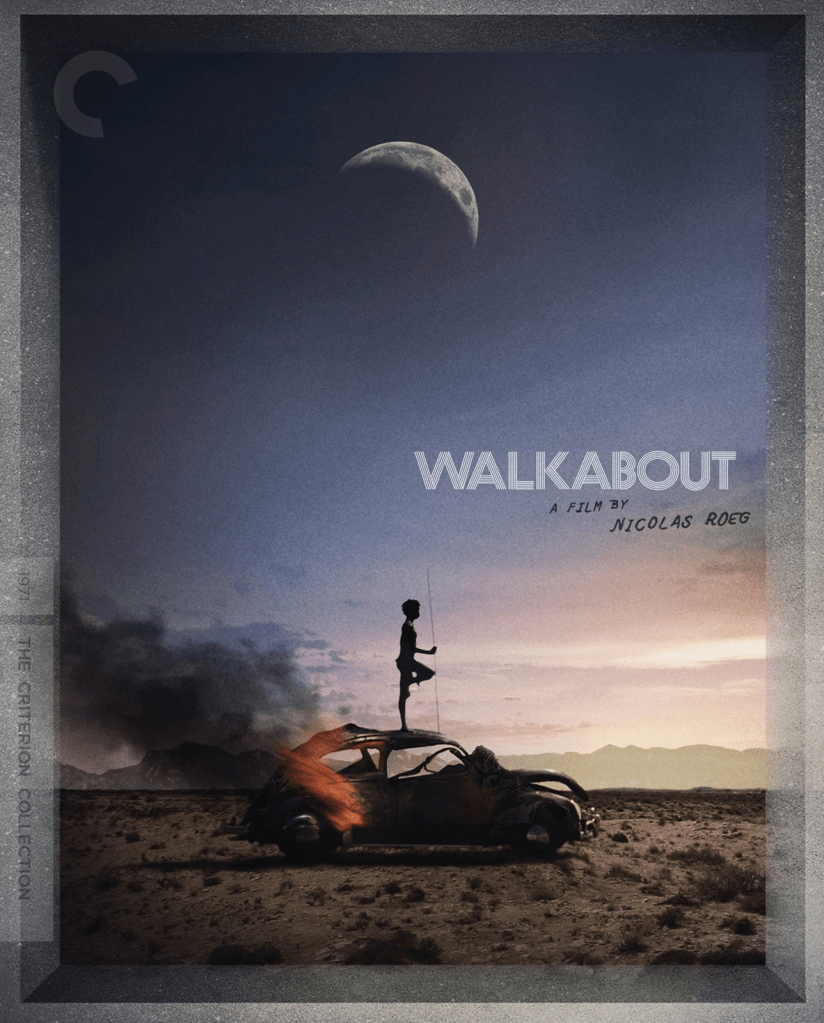
  • Walkabout (1971) – Nicolas Roeg

    Estrenada en 1971, Walkabout se escabulle furtivamente en un momento histórico curioso, cuando el cine estaba dejando atrás las reglas heredadas y buscando formas de expresión más elementales. Era apenas el segundo largometraje (el primero en solitario) de Nicolas Roeg, tras la volátil colaboración de Performance, y ya llevaba la inconfundible firma de un cineasta poco interesado en dar seguridades. Adaptada libremente de la novela homónima, el guion descarta la mayor parte de la estructura declarativa del libro en favor de algo más parecido a un rito cinematográfico. El significado no se transmite, más bien se soporta.

    Rodada íntegramente en el interior de Australia, la película trata el paisaje no como un telón de fondo, sino como una presencia viva e indiferente. La decisión de Roeg de actuar como su propio director de fotografía intensifica este efecto. La cámara absorbe el calor, la distancia y el agotamiento. El diálogo se reduce al mínimo y los pasajes prolongados se desarrollan en silencio, como si el lenguaje mismo fuera una importación colonial inadecuada para el terreno. La comprensión surge, en cambio, a través del montaje, de la colisión de imágenes que se niegan a reconciliarse.

    El reparto profundiza esta crudeza inmediata. David Gulpilil, con solo dieciséis años y sin experiencia como actor, se mueve con una naturalidad que parece más vivida que interpretada. Jenny Agutter, apenas mayor que su personaje, encarna la adolescencia como una frágil negociación entre el condicionamiento social y el instinto inarticulado. Que la película fuera inicialmente un fracaso comercial, incluso cuando se proyectó en competición en el Festival de Cannes, ahora parece inevitable. Desde el principio, estaba desalineada con la comodidad, comprometida en cambio con un cine de exposición.


    La película comienza en los suburbios de Sídney, un mundo de aulas, tráfico e interiores regulados, interrumpido intermitentemente por imágenes fugaces de la naturaleza y la presencia aborigen. La civilización parece ordenada y completa, hasta que de repente revela su fragilidad. Un padre lleva a su hija adolescente y a su hijo pequeño al Outback con el pretexto de una excursión informal. Lo que sigue no es una decadencia gradual, sino una ruptura psíquica. La violencia llega sin explicación y el orden social se desvanece a una velocidad aterradora.

    Abandonados en un paisaje que no ofrece ninguna guía narrativa, los chicos comienzan a caminar. Sus provisiones se agotan rápidamente y el Outback se impone no como una fuerza malévola, sino como una indiferencia radical. La sed, el calor y la distancia se transmiten a través de la duración más que del espectáculo. La supervivencia surge por casualidad, gracias a un pozo de agua, a la persistencia, al rechazo a detenerse.

    El encuentro con otro adolescente, un aborigen, en su viaje altera la gramática de la película. El lenguaje falla casi por completo, pero la comunicación florece a través de los gestos y la necesidad. Su conocimiento de la tierra contrasta con la dependencia de los chicos de los objetos y hábitos importados de otros lugares. Les enseña a cazar, a encontrar agua, a leer señales invisibles para ojos inexpertos.

    El chico se adapta rápidamente, con una curiosidad libre de convenciones. La chica se resiste de forma más sutil, conservando rituales de limpieza y lenguaje que la atan a un orden desaparecido. A lo largo de su viaje, Roeg escenifica colisiones entre mundos. Cadáveres y máquinas, rituales e industria, silencio e intrusión coexisten sin comentarios. La civilización no desaparece. Reaparece en formas rotas, absorbida por un paisaje que ni juzga ni consuela.


    No llegué primero a esta película. Llegué a ella de forma indirecta, años antes, a través de otro filme que hace las veces de un remake descafeinado, dirigido por Mikael Salomon, producido por Disney y Amblin: Kalahari (1993). Se trata de la segunda película donde aparece una (entonces) muy joven Reese Witherspoon.

    Vi Kalahari en VHS durante mi propia adolescencia, sin reconocer lo que estaba tomando prestado o lo que se negaba cuidadosamente a transmitir. Ese encuentro anterior fue importante. Enmarcó la naturaleza salvaje como una aventura en lugar de una prueba, la supervivencia como la formación del carácter en lugar de la exposición psíquica.

    Ambas películas siguen a niños blancos guiados a través de un paisaje implacable por el conocimiento indígena. Sin embargo, mientras Roeg comienza con el colapso y el horror tácito, Mikael Salomon ofrece villanos, impulso y tranquilidad. El trauma se exterioriza. La alineación moral nunca se pone en duda. La naturaleza salvaje se convierte en una prueba que hay que superar, no en una realidad que desmantela la ilusión.

    Como espectador más joven, encontré en Kalahari consuelo en los diálogos que explicaban las emociones, en las amistades que se desarrollaban de forma limpia, en el peligro que, en última instancia, afirmaba el crecimiento. La diferencia cultural estaba presente, pero siempre era superable. La violencia, cuando llegaba, se suavizaba y se narrativizaba. La tierra era vasta, pero existía para ser atravesada.

    Encontrarme con la película de Roeg más tarde fue como entrar brutalmente a la realidad. Todo lo que se había suavizado regresó con fuerza. La falta de comunicación que nunca se resuelve. El deseo que no puede nombrarse a sí mismo. El conocimiento que no puede compartirse sin pérdida. La educación occidental resulta, en el mejor de los casos, ornamental. Los lazos que se forman son reales e intensos, pero provisionales, incapaces de sobrevivir a la traducción de vuelta a la civilización. Lo que más me sorprendió fue reconocer lo cuidadosamente que me había protegido la película anterior.


    En esencia, Walkabout es menos una aventura que una acusación. La sociedad occidental se presenta como profundamente alejada del mundo natural que dice dominar. Separada de sus apoyos artificiales, se derrumba rápidamente. Los chicos no fracasan porque la tierra sea cruel, sino porque han sido educados lejos de ella. El conocimiento llega de forma abstracta y en gran medida inútil cuando la supervivencia exige intimidad en lugar de teoría.

    Esta alienación conlleva una carga colonial. El conocimiento aborigen sostiene a los chicos, pero sigue sin asimilarse conceptualmente. La ayuda se acepta sin comprenderla. La comunicación flaquea no solo por el idioma, sino por la incompatibilidad de las visiones del mundo. La traducción se revela como una fantasía.

    El colapso del padre funciona como la metáfora más brutal de la película. Su respetabilidad de clase media enmascara un agotamiento psíquico que la vida capitalista moderna ni reconoce ni repara. Cuando se quiebra, lo hace de forma absoluta, dejando al descubierto la fragilidad que se esconde bajo la civilidad.

    Roeg derrumba las jerarquías morales mediante un montaje que alinea la caza indígena con la carnicería y el consumo occidentales. La violencia no ha sido eliminada, solo anestesiada. La insistencia de la chica en la limpieza y el decoro revela lo profundamente arraigado que está el condicionamiento cultural, incluso cuando el cuerpo se debilita.

    Una estación meteorológica abandonada se erige como un monumento a la arrogancia tecnológica. Las voces de la radio parlotean vacíamente en la inmensidad. La escasez resulta ser perceptiva más que material. A través de imágenes de minería e intrusión, la película amplía su crítica a la explotación medioambiental. La civilización aparece como una fina capa que se extiende sobre los instintos que se niega a reconocer.


    A veces pienso que necesitaba Kalahari para sobrevivir a mi encuentro con Walkabout. El visionado anterior me ofreció una ilusión temprana en la que se podía honrar la diferencia sin desestabilizar el mundo que la enmarcaba. Sembró el respeto sin preguntar quién controlaba la historia ni a qué precio se garantizaba ese respeto.

    Esa seguridad se convirtió en el andamiaje que Roeg desmantelaría más tarde. Al ver su película como adulto, no sentí sorpresa, sino implicación. Las certezas morales se revocaron silenciosamente. La amistad ya no garantizaba el entendimiento. Las buenas intenciones ya no absolvían el desequilibrio. La propia narrativa de la aventura reveló su complicidad en un romance de paso por tierras nunca imaginadas como mundos plenamente habitados.

    Lo que cambió fue mi visión. Donde antes había celebrado la diferencia dentro de estructuras familiares, ahora me veía obligado a enfrentarme a las propias estructuras. El poder impregnaba cada gesto. El privilegio hablaba a través del silencio. La falta de comunicación dejó de ser un trágico accidente y se convirtió en una condición filosófica.

    La ruptura estética reflejaba la intelectual. La narración lineal dio paso a los fragmentos. La preocupación por el medio ambiente reapareció ligada a las historias de extracción y borrado. La tierra ya no era un escenario. Era testigo.

    En este paso de una película a otra, reconozco mi propio movimiento desde la tranquilidad liberal hacia algo más frágil y más honesto. Un abandono de la fantasía de que la comprensión siempre está disponible, de que la armonía es el resultado natural de la proximidad. Roeg me dejó con un dolor, y con gratitud por ello. Algunas películas no consuelan. Te alejan de quien eras y, en ese alejamiento, te ofrecen el único despertar que se siente merecido.


    «La civilización se acaba. La tierra permanece».

    Tagline promocional de la película


  • Personal review of Wong Kar Wai’s “Chungking Express” (1994)

    Wong Kar Wai arrived at cinema like a rumor drifting through the alleys of Hong Kong, already half-true and half-invented. Before Chungking Express he had traced a feverish map of longing across the city with As Tears Go By and Days of Being Wild, films that felt less like stories than like moods that had found human faces. He was not a director who built monuments. He built weather. Neon rain. Cigarette smoke that remembered the mouths it had left. By the early nineties, the Hong Kong New Wave had matured into something restless and polyphonic, a cinema intoxicated with velocity and homesickness at once. Wong absorbed that energy and bent it inward. While others were refining genre, he was loosening it, letting the camera wander and the script breathe, turning plots into pretexts for encounters. The antecedents of Chungking Express lie as much in the exhaustion of gangster romanticism as in the director’s own creative impasse. He was stalled on Ashes of Time, a period epic swollen with dust and doubt. Instead of forcing it forward, he fled sideways, back to the city, back to the convenience stores and snack bars where hearts could break in the time it takes to buy a soda. He shot quickly, intuitively, as if stealing glances. Christopher Doyle’s camera became a nervous system, jittery and tender, capturing faces that were always about to be lost. The film inherited the nervous pulse of a place on the eve of transformation, Hong Kong still bright with its own reflections, already rehearsing disappearance. It is from this pressure between speed and melancholy that Chungking Express was born, not as an experiment but as a confession whispered at full volume.

    Chungking Express opens like a chance encounter, as if you had turned a corner too quickly and walked straight into someone else’s memory. The film is less interested in announcing itself than in happening to you. From its first images, the city is not a backdrop but a pulse, an organism of escalators and rain-slicked streets, of snack bars glowing like aquariums at midnight. The camera does not merely observe Hong Kong, it keeps pace with it, stuttering and gliding, catching fragments the way a distracted mind does. Two stories brush shoulders without greeting, linked more by atmosphere than by plot, by the shared humidity of heartbreak. The first half is compressed and jittery, all forward motion and nervous jokes. The second loosens into something airier, almost domestic, as if the film itself were exhaling. What unifies these halves is not narrative but a temperament. Chungking Express believes that the most consequential events of our lives often masquerade as errands. Buying a drink. Cleaning a counter. Waiting for a call that may never arrive. The film’s world is built from such gestures, but it frames them with the gravity of rituals. Light refracts through glass until it feels like a mood. Time fractures into overlapping impressions. We are not guided through a story so much as invited to drift inside one. It is a film about being briefly available to oneself. It understands that modern solitude is crowded, that anonymity can be intimate, that the smallest objects often bear the heaviest emotional freight. Even before it tells us anything, the film teaches us how to watch it. Not for answers, but for the way a face can suddenly seem like a room we have entered without knocking.

    What gives the film its peculiar ache is not merely its bifurcated structure, nor the charm of its performances, but the way it smuggles metaphysics into the everyday. Expiration dates. Timing. Love that reveals itself only in hindsight or never at all. In this world, emotions are perishable goods, stamped with invisible numbers. The idea is absurd and devastating in equal measure. We laugh at a man stockpiling pineapple cans that expire on May 1st, yet the laughter catches because we recognize the instinct. We too hoard objects to stand in for endings we cannot pronounce. The film understands that romance often unfolds in the margins of schedules and the glow of fluorescent lights. People brush past one another like radio stations, occasionally aligning long enough for a song to leak through. Love goes unrevealed not because it is rare but because it is mistimed. A door opens a second too late. A message plays to an empty room. A woman cleans a stranger’s apartment as if she were auditioning for a life that does not yet know her name. The expiration date becomes a talisman against chaos, a way of pretending that heartbreak follows the logic of groceries. Yet the film keeps insisting on the opposite. Feelings do not spoil according to calendar. They ferment. They evaporate. They haunt. In Chungking Express the ordinary props of urban life become metaphors without losing their surfaces. A bar of soap holds a confession. A towel carries the residue of a presence. A song repeats until it becomes a spell. This is cinema that trusts the viewer to feel first and interpret later, to accept that timing is the true antagonist and unrevealed love the most faithful companion.

    I first met the film when I was young enough to believe that infatuation was a weather system I could predict. Asian cinema had begun to seep into my life like a new color. It did not announce itself. It simply changed the way rooms looked. I remember sitting in a darkened space, the air faintly metallic with anticipation, and finding myself mirrored in the first policeman’s quiet absurdity. His rituals felt like my own. The way he spoke to objects because they could not contradict him. The way he mistook accumulation for control. I had my own pineapples, my own arbitrary dates that I pretended were choices. I was fascinated by the speed of it all, the sprinting figures blurred into calligraphy, the sudden hush when a face filled the frame. The city of the film was not my city, yet it recognized me. I loved how heartbreak could be filmed without violins, how comedy could smuggle grief, how a man could fall for a woman in a blonde wig and never truly meet her. In those days I watched Chungking Express as if it were a promise that style itself could be a form of courage. I believed I could outpace loss by narrating it. If I named the feeling, if I found the right song to put it in, maybe it would not expire. The first policeman’s faith in small gestures felt heroic. He was a man who thought he could outwit time by bargaining with cans. I did not yet know that time does not bargain. It accepts. Years later, I can say something else with a gratitude that still startles me. I have been lucky enough in life to stop looking for a May and to be found by my Faye. To realize, without fireworks, that the room had changed while I was out. That someone had been caring for the space I would become. This does not cancel the melancholy of the film for me. It deepens it. It gives those early identifications a second echo, not of correction but of continuation.

    Somewhere along the way, without ceremony, I crossed the invisible line between the film’s halves. Now, when I return to it, I recognize myself in the second policeman’s quieter surrender. He is less frantic, more porous. He lets the world rearrange his apartment. He lets a woman love him in secret because he is not ready to be seen. There is a particular loneliness to adulthood that the film captures without diagnosis. It is the loneliness of knowing that the right feeling can arrive at the wrong hour and still be right. I watch him listen to the same song until it becomes both comfort and irritant, a reminder that repetition is the price we pay for being alive in a city. I recognize the way he mistakes inertia for peace. How he thinks that keeping the door closed is a form of stability. Growing older has made me less enamored of the film’s velocity and more attentive to its pauses. The shots of empty corridors, of aquariums glowing like private planets, of a woman sitting on a bed that is not hers. These are not decorative interludes. They are the film thinking. When I was younger, I wanted to run with the camera. Now I want to sit with it. I feel the weight of the unrevealed love more acutely, not as a romantic flourish but as a daily practice. We love in advance. We love in rehearsal. We love people we have not yet met because they fit the negative space of our routines. The disturbance of the film today comes from how gently it refuses to console. It does not tell me that the missed encounter will be redeemed. It tells me only that the miss is part of the encounter. In our present world, saturated with messages that never stop arriving, how often do we mistake contact for connection. How often do we curate ourselves into invisibility. The film asks these questions not by posing them but by living them. They unsettle because they are not puzzles. They are mirrors.

    [5] To watch Chungking Express now is to feel the tremor between nostalgia and diagnosis. The city it preserves has multiplied its screens and thinned its silences, yet the ache it records has not aged. If anything, it has learned new dialects. We scroll past one another with the same distracted intimacy that once belonged to midnight snack bars. We leave traces in digital apartments, likes as fingerprints, stories as towels still damp with intention. The film’s unanswered questions press more urgently against the present. What is the half-life of a feeling when it can be archived. Does repetition anesthetize or sharpen desire. Can a song still save you if an algorithm chose it. The film never offers conclusions, only conditions. It suggests that love’s most radical act may be to arrive without spectacle, to change a room while its occupant is away. There is a courage in that modesty that contemporary cinema often forgets. Wong’s film remains incisive because it does not pretend that we can manage our inner weather. It proposes instead that we learn to walk in it, to accept being drenched. The expiration dates were always metaphors, but they were also alibis. We wanted permission to let go without confessing that we were afraid. The film strips that permission away and leaves us with the harder tenderness of attention. To notice a stranger. To care for a space. To let the unanswered disturb us into a more precise listening. In the end, what endures is not the romance but the way of seeing. The film teaches the eye to be a heart. It trains us to find the extraordinary in the most provisional corners of a life. It asks us to remain open even when openness has failed us before. And then it steps aside, humming, leaving us alone with the echo of a thought we might never resolve.

    If memories could be canned, would they also have expiration dates?

    Cop 223, Takeshi Kaneshiro.

  • Inside the Zone: On Tarkovsky’s Stalker

    There is a place in Andrei Tarkovsky’s Stalker [*] that cannot be mapped. It has no reliable origin story, no stable laws, no geometry that remains obedient. It is called the Zone, but the name is too precise for what it contains. It suggests territory, boundary, a thing that can be outlined. The Zone, however, does not present itself to be surveyed. It absorbs. One does not so much enter it as begin, quietly, to belong to it.

    Inside, direction loosens its authority. Forward becomes hesitation. Distance becomes duration. Space thickens into time. The ground feels less solid than remembered. The air seems already inhabited. Nothing explains itself. Nothing verifies. The Zone does not threaten, persuade, or instruct. It waits. And in its waiting, it rearranges the interior life of those who move through it.

    At the center of this suspended terrain lies a room said to grant desires. But the promise is immediately qualified. The Room does not fulfill what one asks for, but what one truly wants. Not the sentence, but the grammar. Not the wish, but the mechanism that produces wishing. It offers not fantasy, but exposure. The desire beneath desire. The impulse beneath self-image. The truth one survives by not naming.

    This is why the journey is unbearable.

    Three men walk, but it is not their bodies that change position. What moves is certainty. What erodes is orientation. They are not constructed as conventional characters so much as embodiments of intellectual and spiritual postures, slowly unfastened by a place that refuses to hold them in place.

    The Stalker lives by belief. Faith is his vocation, his refuge, and his necessity. He guides others into the Zone with a devotion that resembles priesthood, not because he expects redemption, but because he needs hope to remain active in the world. He does not seek the Room for himself. To enter it would be to complete what must remain incomplete. His meaning resides not in fulfillment, but in escort. He survives by proximity to possibility.

    The Writer carries a crisis of expression. His talent has lost urgency. His words no longer feel anchored to necessity. He comes seeking ignition, the return of a demand he can no longer generate on his own. Yet his longing is threaded with dread. The Room may not restore him; it may clarify him. It may reveal that behind his cultivated despair lies something smaller than suffering, something more humiliating than failure. That the deepest desire may not be tragic, only ordinary.

    The Professor brings with him the language of systems. He measures, calculates, names. But as the Zone unfolds, his instruments lose authority. Skepticism turns defensive. Knowledge becomes a form of evasion. What he fears is not that the Room is illusion, but that it is exact. That something exists which cannot be dismantled into parts without losing what gives it power.

    They move through flooded corridors, abandoned chambers, fields threaded with rust and moss. Objects persist after meaning has withdrawn from them. The world appears not as destroyed, but as outlived. Nature does not console here. It testifies. It grows over what once claimed permanence. Home has been mislaid. History has collapsed into texture. The future has already begun to decay.

    Nothing in this journey resembles adventure. There are no escalating trials, no victories, no decisive revelations. There are only pauses. Prolonged, deliberate, uncompromising.

    Tarkovsky’s camera does not pursue. It abides. It allows time to collect within the frame. Shots are not held so much as inhabited. The film does not progress; it settles. It permits duration to do what narrative usually prevents: it destabilizes attention. It replaces anticipation with presence. Sound thickens. Dripping replaces dialogue. Wind replaces intention. Footsteps become questions. Silence becomes architecture.

    Gradually, the Zone discloses its function. It does not test the men; it translates them. It externalizes interior weather. It reshapes psychological disturbance into geography. Each flooded passage, each trembling field, each room emptied of function corresponds less to danger than to hesitation. The landscape is not hostile. It is intimate.

    The threat is recognition.

    The Room does not judge, correct, or redeem. It fulfills. It confirms the silent author of one’s decisions, the unseen center organizing desire. To enter it is to consent to being known by something that cannot be reasoned with or persuaded.

    This is why they stop.

    Not because they cannot continue, but because continuation has acquired a different meaning. Movement has become moral. Arrival has become exposure.

    Tarkovsky does not construct toward answers. He composes toward conditions. Toward interior climates. His cinema does not argue; it listens. Images do not signify; they resonate. Meaning does not arrive; it condenses. This is “sculpting in time” not merely as technique, but as ethic. Time is not what carries the film. Time is the film’s primary substance. Duration becomes the medium. Waiting becomes the action. Uncertainty becomes the central event.

    Stalker is not about miracles. It is about the terror of sincerity. About what remains when belief, knowledge, and ambition are stripped of their protective language and one is left with the obscure machinery of desire—its blind persistence, its indifference to dignity, its refusal to align with narrative.

    What do you want, when no one is there to hear the answer?

    The film never resolves this question. It constructs a silence large enough for it to persist without closure.

    When Stalker ends, nothing has been solved. No truths descend. No revelations stabilize. Yet something has been displaced. The Zone does not remain onscreen. It migrates. It relocates into the viewer as a condition rather than a concept. The film becomes less an object than a place one has visited.

    And like all real places, it does not vanish when one leaves.

    It waits.

    Stalker does not offer meaning. It removes the scaffolding that usually impersonates it. What remains is not emptiness, but depth: the slow, unshielded presence of not knowing, not as failure, but as the most honest state the film can give us.


    [*] Footnote:

    The term stalker in Tarkovsky’s film does not carry its contemporary English connotation of harassment or predation. It comes from the Strugatsky brothers’ novel Roadside Picnic, where “stalkers” are illegal guides who enter the forbidden Zone to retrieve artifacts or lead others through its dangers. The word suggests someone who moves cautiously, attentively, and at personal risk—part tracker, part trespasser, part devotee. In Russian usage, the term was adopted from English but inflected by context: it evokes stealth, watchfulness, and someone who advances by feeling their way forward rather than mastering territory. In Tarkovsky’s film, the stalker becomes less a smuggler or adventurer than a spiritual intermediary—one who leads others into uncertain ground not to conquer it, but to submit to it.